Showing posts with label Learning. Show all posts

Sunday, August 26, 2012

Gender & Belonging, Part 3: How Feminism Left Men Behind

Even with the wage gap and gender discrimination and all the feminist literature sitting on my bookshelves, something has me questioning my “second sex” status. If I could turn back time, I’m not sure I’d want to go through life as a man. Even with pervasive patriarchy in today’s society, I’m grasping my Girl Card with a firm grip for one big, selfish reason:

I know I’m getting a seat on the lifeboat.  

You see, men’s large-group social structure may provide them with big rewards, but it also comes with a big cost: male expendability, or the “women and children first” dynamic.  Patriarchy has led men to the boardroom, but also to the bottom of the ocean and the cold dirt of a battlefield.

So why are men disposable?  

Male expendability makes sense from an evolutionary perspective.  For a species struggling for survival, every woman counts.  But one man can do the job of many.  In the words of Dr. Greg Hampikian in the New York Times, “If all the men on earth died tonight, the species could continue on frozen sperm. If the women disappear, it’s extinction.”

According to social psychologist, Dr. Roy F. Baumeister, this male expendability traditionally meant that men could engage in riskier behaviors.  These risks could have been for good (standing in a lightning storm with a kite to discover electricity) or bad (mustering up in a warzone).  So the next time your boyfriend talks about the male need to “spread his seed,” just remind him that his ability makes him disposable to society (and then give him a hug).

Curiously, patriarchy may have evolved as a disproportionate backlash against this male disposability.  If their disposability breeds insecurity, then perhaps our male ancestors desired increasing levels of control over societies as a means of securing their futures within it.  Or, more generously, the biological need to care for women may have morphed into restrictions on their rights. As explained by this non-academic-yet-very-thought-provoking YouTube contributor, Karen: “The drive to protect women from harm has resulted in extreme limits being placed on women’s mobility, their agency, and their power of decision to direct their own lives all throughout history...”

Fast forward to the 19th century, and women’s rights movements began the long struggle against these limits on their rights.  Feminism - a movement I proudly support - is a backlash against patriarchy. I remain deeply indebted to the courageous women who came before me, who stood up for the radical idea that I should be thought of as equal to my husband.  And the Feminist mission is hardly complete. The quest for equal gender rights continues today, in distant corners of the world and in the minds of our political leaders speaking on TV.

But male expendability is something that modern Feminism has not addressed, and I think it’s a significant omission.  As YouTube Karen explains, the omission of male disposability pollutes the Feminist mission:

Feminism’s greatest victories have only reinforced in everyone that society still owes women provisions, protection, health and support just because they’re women... [It] teaches us to put women’s needs to the forefront of every single issue, whether that issue is domestic violence law, sexual assault, institutional sexism, [etc.]... Feminism has done nothing but exploit this dynamic, this expectation on men to put everybody else before themselves, especially women.

She also addresses female privilege, which is a byproduct of male disposability:

Feminists will insist that... restrictions placed on women...are the ultimate form of objectification.  You lock up your possessions to make sure that they will never be...harmed.  Honestly, if I were a guy on a battlefield, I might appreciate being objectified that way.  If I’m going to be an object, I’d rather be a sexual one.

This omission of male expendability is a very first-world, 21st-century feminist problem.  To even consider it presumes the evolution of women’s rights to an acceptable point.  I can hardly imagine rape victims in the Congo or Elizabeth Cady Stanton considering men’s rights in this way.  

But male disposability is still a feminist issue that needs to be addressed.  If women seek gender equality, then we need to acknowledge our disadvantages and our privileges.  Men may run the world for now, but they also run into battle for us.  To get to the boardroom, women might need to give up our seat on the lifeboat.

Saturday, August 25, 2012

Gender & Belonging, Part 2: The Social Roots of Patriarchy

I have something in common with biology professor at Boise State University.  We both published articles espousing the virtues of femaleness this weekend.  Mine on my humble little blog; his on the New York Times.  Chock-full or Y-chromosome shaming, Greg Hampikian’s partially satirical article “Men, Who Needs Them?” might get him kicked out his fantasy football league this year:

It’s true that men have traditionally been the breadwinners. But women have been a majority of college graduates since the 1980s, and their numbers are growing... Meanwhile women live longer, are healthier and are far less likely to commit a violent offense. If men were cars, who would buy the model that doesn’t last as long, is given to lethal incidents and ends up impounded more often?

For the record, I would buy the man car because it’s cute and has a nice rear.

Even with these pro-women articles, including my own, it’s hard to feel bad for men, isn’t it?  They have it pretty good these days, at least from the vantage point of my couch. The two folks running for President are both men (though I wouldn’t mind if Hillz was added to the ticket); men lead 488 of the Fortune 500 companies; and even influential women in academia and government struggle with gender discrimination.

So where did patriarchy come from?

Patriarchy's theoretical roots are numerous and oft-debated. But one interesting explanation for the origin of male-dominance of our societies comes from Dr. Roy F. Baumeister, a professor of social psychology at Florida State University. He credits the evolution of patriarchy to the structure of men’s social groups.  While women prefer smaller, more intimate social groups, men seek larger, shallower groups.  Being part of a larger group encourages individuals to specialize and take risks to distinguish themselves from the rest:

…[M]en think of themselves based on their unusual traits that set them apart from others, while women’s self-concepts feature things that connect them to others.  [S.E. Cross and L. Madsen] thought that this was because men wanted to be apart from others. But in fact being different is vital strategy for belonging to a large group. If you’re the only group member who can kill an antelope or find water or talk to the gods or kick a field goal, the group can’t afford to get rid of you.

As specialization occurred, culture developed around men's social groups, and hence evolved patriarchy:

…[I]t’s just that the women’s sphere remained about where it was, while the men’s sphere, with its big and shallow social networks, slowly benefited from the progress of culture. By accumulating knowledge and improving the gains from division of labor, the men’s sphere gradually made progress.

Even today, this gender discrepancy of social ordering may be holding women back.  Take the wage gap, for example.  A study published in Organization Science called “Engendering Inequity? How Social Accounts Create vs. Merely Explain Unfavorable Pay Outcomes for Women,” found that the perception of women in the workplace puts them at a disadvantage.  Kerry Hannon wrote about this study here:

“Research on stereotyping shows that people assume that women care more than men do about communality and belongingness and that men care more than women about their own attainment and self-interest,” wrote Maura Belliveau, the study’s author, an associate professor at Long Island University. For this reason, the managers generally felt that the women would be able to recognize the need for the cutbacks and would not feel as personally offended as the men if they received small raises.

So women may be willing to accept less pay because of their strong social desire to belong. 


This intimacy/attainment trade-off has interesting implications for both genders. If women value intimate relationships, they may bring home less bacon; if men attain positions of power, they may have more shallow relationships.

In second grade I asked everyone on the playground a precocious question: “If you could go back to when you were born, would you rather be a boy or a girl?”  All the boys said boy, and all but one of the girls said girl. (The dissenter said in all seriousness that she would have rather been born a boy, which was quite the playground controversy back then.  It may have been a playful hypothetical on her part, but I can’t help but wonder if that little girl might have known that something was different about her sexual orientation, even at 6 years old.)

Even with the wage gap, gender discrimination, and all the feminist literature sitting on my bookshelves, I think I’d still answer “girl” because, in a most significant way, I feel more valuable than a man.  Maybe patriarchy is really just a backlash against a fundamental male insecurity: that they’re disposable.  I’ll explore male expendability in Part 3.  

Friday, August 24, 2012

Gender & Belonging, Part 1: Women & Belonging

Today I read a Slate article about the pervasive influence Great Lakes cities are having on American vowel sounds. As a Hoosier transplant in Chicago, I recognized the dialects referred to in the piece. I hear them every time I turn on the five o’clock news and hear the voice of a Chicago police officer, government official, or any lawyer involved in the Drew Peterson trial.  But one line at the end of the article piqued my curiosity about dialect adoption:

“While our skin color is often the first and most obvious indicator of our membership in a social group, our dialect is the first outward signal that we consciously influence.”

I started hearing the Chicago dialect regularly when I went to college at a school where 80% of the student body was from the suburbs of the city.  Mid-freshman year, a few of my friends from Indiana and downstate Illinois made an empirical observation: girls from the suburbs tended to be the ones with the strongest Northern accents, not the boys.  (Folks raised in the city most often had an accent.)  

More empirics: my father-in-law and my previous boss were born and raised in the same part of New York City during mid century.  But my boss, a woman, is the one who still calls coffee “cwoh-fee.”  And a dear girlfriend of mine who moved to Texas a few years ago now says “y’all” more than her native-born Texan husband.  It’s adorable.

It's not just me noticing this gender discrepancy.  According to this New York Times article, women do adapt to linguistic changes quickly:

“It’s generally pretty well known that if you identify a sound change in progress, then young people will be leading old people,” said Mark Liberman, a linguist at the University of Pennsylvania, “and women tend to be maybe half a generation ahead of males on average.” Less clear is why. Some linguists suggest that women are more sensitive to social interactions and hence more likely to adopt subtle vocal cues.”

So, does A + B = C : If our dialects are our “first outward symbols” of belonging to a group, and if women adapt more quickly to dialects, then do women have a stronger need to “belong” than men?

From an evolutionary perspective, we all need to feel like we belong to a group.  Banding together and the comfortable feelings of kinship that accompany collective identity have helped ensure the survival of our species.  But maybe women value belonging differently than men.  University of Michigan professor, Bonnie Hagerty, studied college students’ feelings of belonging and concluded that, “being able to say ‘I belong’ is important to the healthy psychological functioning of men, but it is vital to women’s.” She further noted that

“Those who didn’t feel they belonged were more likely to experience depression, anxiety, loneliness, suicidal thoughts and psychiatric treatment. They also were less likely to be involved in community activities. Women, however, experienced the effects of belonging or non-belonging more acutely than men.”

Aside from my empirical dialect theory, plenty of evidence supports this idea that women value belonging to a group more than men:

  • Women are more likely to be religious than men.  According to the US Religious Landscape Survey published by the Pew Forum on Religion and Public Life, “Women in several Christian traditions are more likely than men to attend religious services at least once a week...”
  • Women spend more time on social networking sites like Facebook.  ComScore, a digital marketing company, reported that as of last year, “In North America and Europe, women spent an average of nearly two hours (30 percent) more than men on social networking sites in October.”
  • Can I see a show of hands of women who often act as the social coordinators of their relationship, meaning you organize the get-togethers with friends, you throw and attend birthday parties, and you remind your partners to send appropriately-timed greeting cards?  Oh, is that almost all of you?  I thought so.  The handwriting on the outside of my birthday card envelopes is always from my mom, aunts, or grandma.  
  • Women are held / women hold themselves to easily definable and highly visible standards of belonging. The cosmetics, weight loss, and fashion industries form a multi-billion dollar beauty industry that profits from our insecurities about not fitting in.  Men are subject to these pressures. But with push-up bras, bronzers, and diet pills, women undoubtedly bear a disproportionate burden of this industry’s influence.  

Dr. Roy F. Baumeister of Florida State University summarized women’s need for belonging in an address he made in 2007.  Referencing a Psychology Bulletin article written by S.E. Cross and L. Madsen, he said,

“Men think of themselves based on their unusual traits that set them apart from others, while women’s self-concepts feature things that connect them to others.” (emphasis mine)

So, perhaps women do have a stronger need to belong than men. We plan parties and send birthday cards because we crave deep, meaningful relationships with our friends and loved ones.  In Baumeister’s words, “women specialize in the narrow sphere of intimate relationships [while] men specialize in the larger group.”  

He further notes that social orientation towards the larger group can foster competition for dominance within it: “In large groups, getting to the top can be crucial. The male preference for dominance hierarchies, and the ambitious striving to get to the top, likewise reflect an orientation toward the large group...”

History aside, these conclusions should have some important implications for women’s participation in halls of power, shouldn’t it?  Putting my international relations education to the side and ignoring the “Self” and “Other” concepts ringing loudly between my ears, I can’t help but wonder: If women really do have a stronger need for belonging to a group, whereas men tend to fight for dominance within it, could women perhaps be ideal world leaders?  If women value relational intimacy, might they be able to forge political relationships better than their male counterparts?  

Our current political paradigm has men at the helm.  Even with all our world troubles, I’m going to give men a solid B+  in running things over the past few millennia because I’m starting to feel kinda bad for them.  As I’ll explore in Parts 2 and 3, men’s large-group social orientation comes with big rewards, but even bigger costs.   

Wednesday, June 6, 2012

The Most Astounding Fact

I hate Facebook sometimes.  The too-political status updates that boil your blood, the jealousy-inducing photo uploads of far-away places that you’ve never visited, and the stomach-dropping realization that you’ve been defriended - all virtual sins that have been trespassed against me, and that I have also trespassed.    
Facebook sometimes makes me angry; it sometimes makes me jealous; but other times, it makes me grateful. You see, a few months ago a stray Facebook status update changed my perspective on life in the universe.  Literally.

Usually I don’t like thinking about the universe.  At all.  In fact, I hate outer space.  The final frontier of black holes, supernovas, and asteroids creeps. me. out.  And not in the way that spiders creep me out.  No, space creeps me out in a life-altering, faith-questioning, what-is-it-all-for kind of way.  If you ever want to thrust me into the throws of an existential crisis, start talking to me about the astrophysical mysteries of outer space.  

But I wasn’t always afraid of space.  Growing up, I watched the Jetsons on TV, constructed an A+ diorama of the solar system with styrofoam balls, and memorized “My Very Excellent Mother Just Served Us Nine Pizzas” in elementary school (Rest in peace, Pluto) - all without questioning my existence on this planet.  But sometime in junior high school, I started questioning the whole “God” thing, and I started to wonder, If there is no God, then why are we here?  These sorts of heavy questions filled my mind with the realization of the emptiness of the universe and our insignificance within it.  Thus my fear of space was born.  

I feel much better about the God question than I did a decade ago, but my outer space anxiety has lingered.  So you’ll never see me watching those stupid Discovery Network shows on the apocalypse, the formation of the universe, and ancient aliens.  I’ve never made my screen saver into pretty images of galaxies.  And I don’t even want to see that new Steve Carrell comedy Seeking a Friend for the End of the World.  Count me out of anything whose synopsis starts with “As an asteroid nears Earth.”  No thanks.

Lately, though, someone has been loosening the straps on my straight jacket of space terror:  Dr. Neil deGrasse Tyson.  He’s an astrophysicist at the Hayden Planetarium who has appeared on several media outlets, including the Colbert Report and the Daily Show - during the latter, he easily triggers a hearty chuckle from the audience by pointing out that the animated earth in Jon Stewart’s opening credits is spinning in the wrong direction.  With his star-speckled neckties and charmingly geek-ish demeanor, Dr. Tyson’s enthusiasm and curiosity for all things Space is positively infectious. He endears me with fun physics facts like these, quoted from his Twitter account:

  • GettingMarried? June's full Moon crosses the sky in a low arc. Atmospheric dust creates an Amber hue. Behold the "HoneyMoon"
  • Astro-educators remain busy undoing damage caused by 1973 hit album "Dark Side of the Moon." Nope. All sides get sunlight.
  • More air molecules in breath of air than breaths of air in Earth's atmosphere. Some air you inhale was exhaled by Cleopatra.

So when a high school friend posted a video of Neil DeGrasse Tyson onto Facebook called “The Most Astounding Fact,” I watched it.  It turned out to be “one giant step” for Anne, helping me overcome my anxieties about outer space.  The irony of it all?  My random facebook friend and I shared two classes together way back when: High school physics and church confirmation classes.


Like.  

Thursday, April 12, 2012

Testify! (on Illinois prisons)

Tuesday morning I was folding laundry and vacuuming up dog fur.  By Wednesday I was sitting in front of members of the Illinois General Assembly testifying on overcrowding in the state’s prison system. Early this week a family member asked me to speak in support of a friend at the Illinois House Judiciary-Criminal Law Committee’s subject matter meeting on prison overcrowding and meritorious good time credit, an early release program that the Governor suspended in 2010.  (You can read about his decision and the House Committee meeting here.)  I didn’t know much about the details, so I figured it would be an informal informational meeting with a few Illinois representatives held in a small austere government office room.  But because my straight-A self doesn’t know how to put a cursory effort into any task, I researched the heck out of the Illinois prison system and wrote a 7-minute-ish long speech in one evening.  

Good thing, because this meeting turned out to be much more formal than either of us realized.  Wednesday morning I found myself in a big, bright wood-panelled committee room at the Bilandic Building on La Salle Street with about 80 other people, including journalists, a cameraman, the Director of the Illinois Department of Corrections and staff from the Governor’s office, and several members of the Illinois House of Representatives.  And when the committee called forward those testifying on “proposed solutions,” I became a little star-struck as I sat down next to the Soros Senior Justice Fellow at Northwestern Law School, whose articles I had referenced in my research (and who was quoted in the above article link).  The last to speak, I read my statement - with gusto - into the skinny table microphone, glancing up purposefully at to the two-tiered panel of Illinois representatives sitting under the state seal: “State Sovereignty, National Union.”  
Afterward, a few people shook my hand and the Senior Justice Fellow said I gave an “excellent speech.”  I was just happy to have had the opportunity to participate so directly in an important civic dialogue. But I shook their hands and took the compliments because they were right: I friggin’ nailed it.  


Here's what I said:

I live in Lincoln Park here in Chicago, and I’m reminded of Chicago’s crime legacy every day.  Not because of gang violence or drug deals in back alleys.  No, because of tourists.  You see, I live near the Biograph Theater on Lincoln Avenue, where John Dillinger was shot dead.  So a few times a week I see long buses of out-of-towners drive by on Chicago Gangster and Untouchables Tours.  So when I was asked to speak here today, I couldn’t help but wonder, in that hugely celebrated era of rampant organized crime and violence in this country, how full were our prisons?

US Justice Department data reports that there was an average of 145,000 inmates in the United States every year during the 1920s and 1930s.   Following that trend and adjusted for population growth, there should be around 350,000 people in our prison system today.

Except there aren’t:  Today’s US prison system houses 2.2 million inmates.

Clearly those tourists on those buses in Lincoln Park are grossly misinformed.  The real era of crime is happening right now apparently, right?  Wrong.  Here in Illinois, between 1995 and 2007, we saw a 44% drop in violent crime and a 30 percent drop in property-related crime.  BUT, during that same time, the incarceration rate grew by 20 percent.

Crime is down, but imprisonment is up.

As if that paradox wasn’t troubling enough by itself, we don’t have enough room for everyone we want to put behind bars.  And Illinois wins the bronze medal of the Prison Overcrowding Games: according to a recent white paper on Good Conduct Credit in Illinois, “only California’s or Alabama’s prison system is more crowded than Illinois’…” Indeed, The Taylorville Correctional Center in downstate Illinois, designed to hold 600 prisoners houses 1,200.  The Lincoln Correctional Center is designed to hold 500 inmates, but today it holds almost 1,000.   In total, 25 of the 28 state prisons are over capacity, and the system currently contains about 50 percent more prisoners than facilities were designed to hold.

So why are our prisons so overcrowded?  When I asked Google that question, its glaring white search results page shouted answers like punitive sentencing laws, the war on drugs, and over-zealous efforts to lock up criminals for minor offenses and parole violations – not to mention the profit motives that drive the prison industrial complex.  All of which increased my admiration for the scope of this committee.

But though the solution may be complicated, prison overcrowding’s impact is simple: it’s bad for everyone.
Prison overcrowding increases costs, increases violence, and reduces rehabilitation.

For me, the taxpayer, it increases costs.  The Illinois Department of Corrections already has $1.4 billion budget, which is greater than all other state government departments excluding healthcare and human services. While each student enrolled in a public school costs the state of Illinois around $6,000 a year, each inmate in an Illinois state prison costs us $25,000 a year.  Considering that at least half of prison inmates are there for non-violent crimes like drug possession, it’s worth noting that – again, while we spend $25,000 to house one inmate per year – the cost of treating a low-level drug offender ranges from $4,000 to $7,000.  We thus must allow ourselves to consider alternative rehabilitation efforts for non-violent offenders, especially when we’re stretching our state prisons and our state budgets so thin.

For prison staff, prison overcrowding means they’re outnumbered and overworked.  When there aren’t enough officers to watch over the inmates, the guards must work overtime.  The East Moline Correctional Center reports that their guards are putting in collectively 200 to 300 hours of overtime per week on each of the prison’s three shifts.  Of course, those overtime hours cost the state thousands of dollars of wages and pension payouts.  One officer noted: “You’re paying retirement on a correctional officer who would normally make $55,000 a year, but because of overtime you’re going to end up paying them retirement for $90,000 to $100,000 per year.”

But we might need to consider that they deserve such a hefty payout because, when prisons get overcrowded, prisons get dangerous, for guards and inmates alike.  The John Howard Association found Illinois facilities that were so crowded that administrators had no choice but to house hundreds of minimum-security inmates in flooded basements and vermin-infested dormitories with broken windows, leaking pipes and dilapidated roofs.  And when inmates are stressed, violence erupts.  In December 2009, one Illinois correctional center inmate took an employee of the prison library hostage for seven hours, and a fight at another center in Canton left one guard with a broken eye socket.

Unfortunately, it seems that the state of Illinois is on its way to attaining a California-level of prison overcrowding, which the US Supreme Court declared unconstitutional last summer:  The court ruled in favor of the inmates because, it said, the medical and mental health burden of prison conditions amounted to a violation of the eighth amendment protection against cruel and unusual punishment.

But overcrowded prisons might endanger people outside the prison walls as well.  Several studies have suggested that overcrowded prisons lead to increased recidivism.  For example, one study conducted in England in the 1980s found a strong relationship between overcrowding and prison effectiveness.  Prisoners released from overcrowded prisons were more likely to be recommitted for subsequent criminal infractions.  The relationship could not be explained away by other variables, leading the head researcher to recommend a reduction in prison overcrowding in order to improve the ability of prisons to reduce crime.

In consideration of these results of prison overcrowding, I find it puzzling that the state would ever enact a policy that would immediately overcrowd prisons.  But that’s what happened in 2010 when Governor Quinn suspended the state’s 30-year-old Meritorious Good Time program that rewarded inmates’ good behavior with a 180-day early release.  This early release program was a humane and cost-effective way of managing prison populations.  But it fell because of partisan politics and the manipulation of public fears.  But we must re-establish Illinois citizens’ confidence in this program - that that the state will always take proper precautions when awarding early release to inmates - – because incentivizing eligible inmates to return home early is a good, logical policy that should be reinstated.

I sit in admiration of this committee because of the scope of the problem you are addressing.  Prison overcrowding is a sticky-side effect of a system where the status quo is overly-punitive and under-funded, and peppered with a heavy dose of partisan politics every time the Governor runs for re-election.  But prison overcrowding is treatable.  We should certainly address punitive sentencing, drug laws, and minor parole violations.  But there’s something we can do right now, something we already did 30 years ago, to ease the burden of prison overcrowding on every Illinoisan.  As a taxpayer and concerned citizen, I urge the state of Illinois to restore the Meritorious Good Time Program or to create a comparable good-conduct program that enables low-level offenders to earn time off their sentences.

Thursday, February 23, 2012

The Chalkboard Resurrection

My Chalkboard Shopping List.
I don't remember exactly when it happened.  Sometime in between playing Oregon Trail on boxy Apple computers in elementary school and typing "asdfasdfasdf;lkj;lkj;lkj" in typing classes in junior high, The Whiteboard Invasion occurred.  Riding the tail winds of the democratization of computers in the 1990s, whiteboards infiltrated my classrooms with their colorful dry-erase marker companions.  Together, computers and whiteboards advanced into the new millennium, leaving powder-ladened chalkboards behind in the 20th century.

But once upon a time, chalkboards were the new technology.  The Headmaster of a high school in Scotland invented the chalkboard probably around the turn of the 19th century.  However, until they become commonplace in America, classrooms and public education in this country were very different than today, as explained by Steven D. Krause in his scholarly article, "'Among the Greatest Benefactors of Mankind': What the Success of Chalkboards Tells Us about the Future of Computers in the Classroom" :   
The description of schools and schooling around 1800 by Paul Saettler in his text The Evolution of American Educational Technology is indeed grim.  Before and around 1800, instruction at the elementary and secondary level was more or less individual study;  “Developing understanding through inductive group discussions was unknown” (32).  Writing instruction seemed to have more to do with making copies of existing texts and "whittling goose-quill pens" (33) than what we might consider "writing instruction" from even a current-traditionalist paradigm.  Page 9
 By the mid-19th century, chalkboards had become ubiquitous in most American schools:
 …It seems to have been an innovation that became synonymous with “schooling.”  Even the small schools in rural and westward lands such as Indiana, Illinois, and Iowa had to have a blackboard… So from almost the beginning, the chalkboard seems to have been a technology that was universally accepted, immediately adopted, and widely praised.  As quoted in Tyack and Cuban’s book [Tinkering Toward Utopia], Josiah F. Bumstead wrote of blackboards in his 1841 book The Blackboard in the Primary Schools that “the inventor or introducer of the system deserves to be ranked among the best contributors to learning and science, if not among the greatest benefactors of mankind” (121).  Page 11
Yet, how quickly chalkboards disappeared from my classrooms in the 1990s, replaced by the identically-functional whiteboards and, most significantly, school computers.  Indeed, by high school, I was taking French lessons on computers in our language lab, copying notes from PowerPoint presentations in my U.S. history class, and writing all my essays and research papers with the help of spell and grammar check in Microsoft Word.  

The ubiquity of computers in 21st century education forces an important, retrospective question:  Is typing better or worse for our brains than handwriting?

Many researches think it's worse, which you can read about here, here, and in this article from the Wall Street Journal:
Using advanced tools such as magnetic resonance imaging, researchers are finding that writing by hand is more than just a way to communicate. The practice helps with learning letters and shapes, can improve idea composition and expression, and may aid fine motor-skill development.
It's not just children who benefit. Adults studying new symbols, such as Chinese characters, might enhance recognition by writing the characters by hand, researchers say. Some physicians say handwriting could be a good cognitive exercise for baby boomers working to keep their minds sharp as they age.
So perhaps we should revive handwriting and the tools that facilitate it, like the chalkboard.  Happily, the popular website Pinterest is leading the Chalkboard Resurrection.  Just type "chalkboard" in the search box, and the results will blow you away with their simple creativity and an old-fashioned beauty that even the shiniest whiteboard couldn't match.

Imagine my delight when I found an old, dusty chalkboard sitting by its lonesome in my parents' garage.  My mom let me take it and even gave me some unused sidewalk chalk she had stored away.  With my new toy at home, I cleaned it off and propped it up against our kitchen counter - and hello new shopping list!   Forget the pen and paper; my new-old chalkboard is really a digital tool in disguise.  Now we just snap a picture of our Chalkboard Shopping List with our smartphone to produce a digital list to use at the grocery store.  So, on behalf of all of us who grew up with you, Chalkboard, welcome to the 21st century.  

Monday, November 21, 2011

My New Hobby

My parents like to save things.  So much so that my childhood home sometimes feels like a museum dedicated to preserving our family memories, some of which would have long been forgotten in my mind if not for the objects peppering the bookshelves in that house.  There are loose photos and yellowed newspaper clippings sitting in shoeboxes in the garage; a dismal 2nd grade craft project constructed with backyard sticks and a heaping dose my 7-year old imagination collecting dust on a living room bookshelf; and a pair of cheap stud earrings from Hook’s Drug Store - which went out of business in 1994 - that I found in the back of a bathroom drawer last year and now keep in my daily jewelry rotation. My parents are certainly doing their part to stop filling up landfills.  

While I share my parents’ sentimental tendency to save things, I’m much more organized with my memory objects.  Whenever I receive a particularly touching birthday card or bring back a souvenir from a family trip, I put it in one of the white boxes tucked away near the bookshelves in my bedroom.  For a few years now, these little boxes have collected my mementos and stored all my good intention to do something with them.  

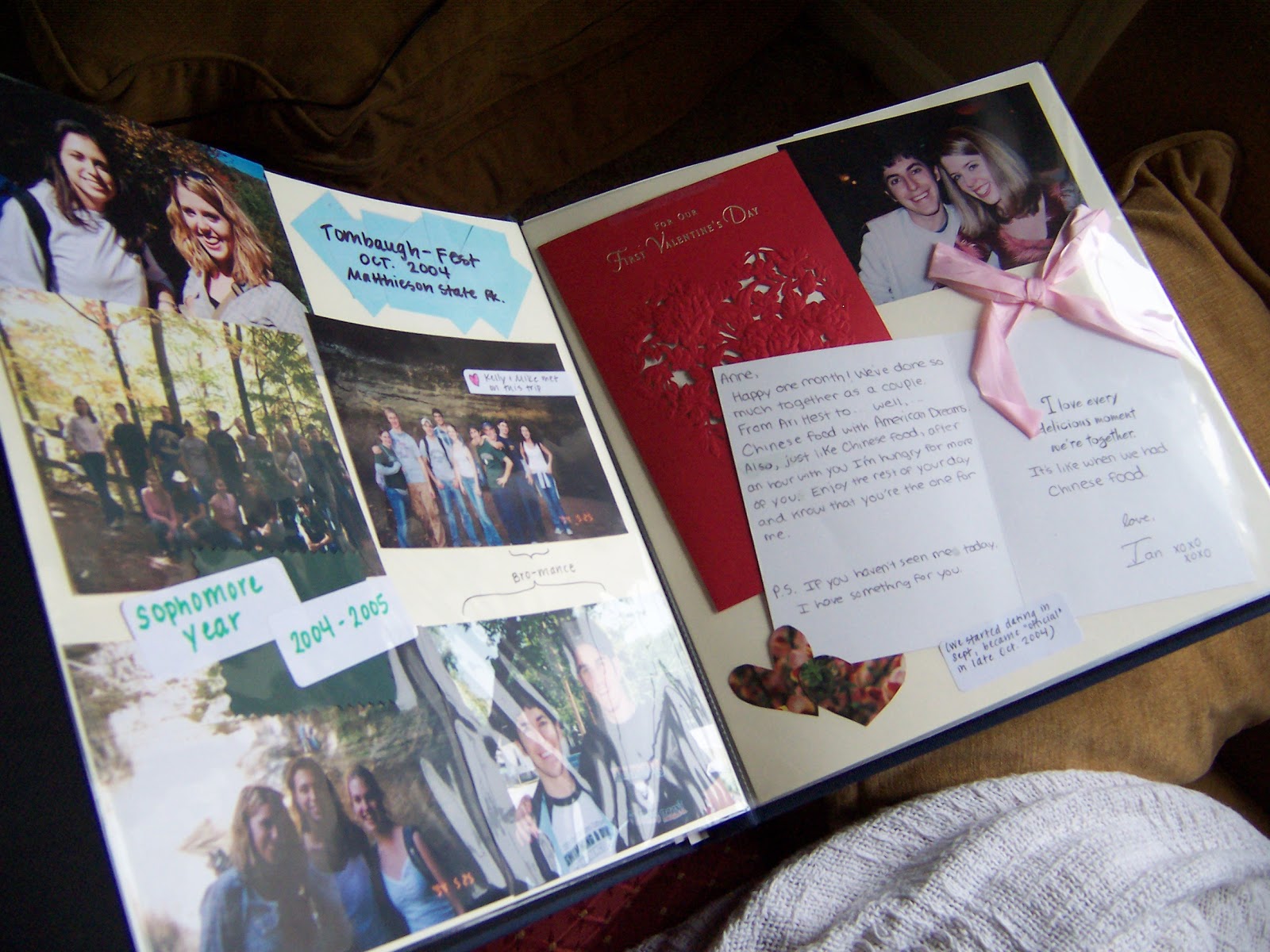
Maybe the Toy Story franchise made me overly-sympathetic to inanimate objects (I’m looking at you Toy Story 3), but the past few months I’d been feeling like my sentimental trinkets had waited long enough for me to organize them in a more meaningful way.  So I finally did something with them last week.  I liberated my postcards, certificates, and photostrips from their white-boxed prison and gently double-sided-taped them into my very first scrapbook.  

Two trips to Michael’s later, and with a new understanding of why scrapbooking supplies take up the first four aisles of that store, my first scrapbook now sits atop the living room bookshelf ready for anyone to enjoy.  Even though it’s fun to exercise my creativity with stamps, stickers, and colorful paper like I’m in elementary school again, scrapbooking is more than just a craft project.  It reminds me why I chose to keep these objects in the first place: Unlike the newspaper clippings waiting in my parents’ garage with no one to look at them and the earrings that waited 16 years to sparkle next to someone’s cheek, the point of having all these mementos from life is to give them a place of honor and enjoyment in our home.

A page from my scrapbook, including hiking photos from college
and a card from my first Valentine's Day with Ian in 2005.

Monday, August 22, 2011

What do you think of when...

Every once in awhile when I’m sitting around with someone and we have nothing to do, I like to play a little association game.  I’ll say “Tell me what you think of when I say these two colors,” and I’ll randomly name two colors like pink and yellow, blue and green, gray and red, etc.  It’s interesting to hear peoples’ associations.  For what it’s worth, those colors remind of Easter dresses, a picture of Earth, and Bowser’s Castle in MarioKart.

This nerdy game I play touches on a deeper issue:  the dichotomy of the universality of human senses and the individual way we each experience them.  We all know what the colors black and purple look like, but I might be the only one in the world who associates those two colors with a Lisa Frank folder I had in elementary school.

So color me tickled when I read an article in The New Yorker about a guy named David Eagleman that mentioned a little phenomenon called synesthesia.  A professor of neuroscience at Baylor University in Houston, Eagleman studies the cool stuff we should have studied in our high school science classes.  This particular article tracks Eagleman’s quest to figure out why time seems to slow down whenever something bad is happening to us.  Very interesting.  But I felt most impacted by the parenthetical aside in this paragraph:

Time isn’t like the other senses, Eagleman says. Sight, smell, touch, taste, and hearing are relatively easy to isolate in the brain. They have discrete functions that rarely overlap: it’s hard to describe the taste of a sound, the color of a smell, or the scent of a feeling. (Unless, of course, you have synesthesia—another of Eagleman’s obsessions.)

After rolling my eyes at the author of the article for making me feel stupid for not knowing what synesthesia is, I looked it up on Wikipedia:

 
Synesthesia...is a neurologically based condition in which stimulation of one sensory or cognitive pathway leads to automatic, involuntary experiences in a second sensory or cognitive pathway.  People who report such experiences are known as synesthetes. In one common form of synesthesia, known as grapheme → color synesthesia or color-graphemic synesthesia, letters or numbers are perceived as inherently colored, while in ordinal linguistic personification, numbers, days of the week and months of the year evoke personalities.  In spatial-sequence, or number form synesthesia, numbers, months of the year, and/or days of the week elicit precise locations in space (for example, 1980 may be "farther away" than 1990), or may have a (three-dimensional) view of a year as a map (clockwise or counterclockwise).

Light bulb!  I am a total synesthete.  It’s August right now, and here’s how August looks in my mind relative to the year:
    March
February               April
January                                May
December                                        June
November                       July
October             August
September

And in school, the grading scale moved from right to left in my mind:
   
    F  D-  D  D+  C-  C  C+  B  B-  B+  A  A-  A+

With wide eyes, I mentioned this to Ian, and he said that he visualizes the TV channels going in different directions, with certain numbers going from from bottom to top, others moving right to left, as if they’re making a square.

Synesthesia is just a grand extension of my color association game.  While the color association game can also show our shared associations (what do you think of with the colors red and green?  Christmas, right?), synesthetes’ perceptions are intensely personal.  Just like the random color combinations.  So even though we may shop at the same stores, drive the same cars, and even export our way of life abroad, our brains won’t let us blend in to the crowd.  Deep down in our thoughts is where we’re our own fierce selves. 

Sunday, July 3, 2011

Chapter Descriptions

I don't sort my closet by color or arrange my DVDs alphabetically, but I consider myself to be a pretty organized person.  To better organize this blog and hopefully to make it more navigable, I'm going to categorize each blog entry into one of the following chapters:
  • Cooking: Chronicles of kitchen fun
  • Saving: My steps and missteps at managing our money
  • Learning: For the love of self education
  • Pondering: General reveries on life
  • Storytelling: Family memories and recent musings from my loved ones
I hope you'll develop a favorite.