Dear Me In 2012,
You are two years into your marriage and people are starting to ask when you and Ian are going to have children. You're wondering the same thing, but you're nervous about how a child would encumber your lives. You think that "having children is the denoument of the slide into adulthood known as 'settling down.'" You're worried you'll regret it.
I'm writing to you from three years in your future. You have a 17-month old. You have stretchmarks and a scar on your belly, pediatrician's bills in your filing cabinet, and an early wakeup call everyday. And you have no idea how you could have ever thought you would regret this.
You're worried about parenthood limiting your wanderlust. No more chats about spending three weeks in Munich or joining the Peace Corps. As of today, your passport has been expired for three years and your fear of flying has little to do with turbulence, and more to do with flying with a cranky baby. (And a carseat. By yourself. True Story.) You like traveling less than you used to. You feel lucky to love being at home.
Plus, you get to visit the remote island nation of James everyday, which is more exotic than any place you've ever pinned on Pinterest. The unique inhabitant of this island has weird customs like throwing food, waking at odd hours, and shrieking at the slightest sensation of any emotion whatsoever. Jamesland is fascinating.
I wish that you would redirect your concerns about world exploration to your friendships because having a baby is going to be a huge shock to all of the relationships in your life. Happily, you are going to make some amazing new friends through James. Nascent as these friendships may be today, when you watch James swing in tandem with a music class friend or steal cheerios from a toddler whose mom you met in birth class, you will silently hope that you'll get to watch these babies grow up together.
But having a baby will be also be an unexpected test on your old friendships. Getting pregnant at 28 means that, of all the friends in your wedding photos, you and Ian will be the first ones to become parents, and that's tough sometimes. You'll feel guilty when you realize it's been two months since you reached out to a friend, when it feels like it's been two weeks. You'll feel isolated when your girlfriends can't sympathize with your frustration at a woman who complained to you about her coworkers leaving work at 5:30 to pick up their kids from daycare when "I have a yoga class at 5:30!"
And you'll feel sad for the friends you start to lose touch with. The initial phone calls of excitement give way to fewer get-togethers and unanswered texts. You'll hope that they still think of you as the same person that you were before James. But your schedule and priorities are different now, so perhaps they think you've changed. They're not wrong.
Most of all you'll feel grateful for your friends. They will bring you doughnuts in the hospital and Chipotle in those bleary first few weeks home; and they'll buy James books and onesies and ask to hold him even though "I don't know what I'm doing!"; and they will still invite you and Ian out to dinner, even though they know you need way more forewarning nowadays. You'll hope that you will someday get to repay the tremendous kindness that your friends have shown you, and you'll want to thank them in a blog post for making you feel like the same version of yourself even in the middle of a huge life change.
Of course, you hate change; you love routine. You've always been a "love-you-have-a-good-day" kind of gal. So introducing precious sweet 8lbs 15 oz angel baby James into your life is going to S-U-C-K at first. But, as it turns out, babies love routine, too. So you'll find your groove again right away, and you'll find comfort in the 7pm bath-book-boob-bed routine with James and the quiet time on the couch with Ian every evening.
Other things will change, too. You'll be more self confident. You won't mind your stretchmarks because of the miracle they represent. Your marriage will get stronger and, the biggest surprise of them all: you'll have better sex, likely for a few reasons: because you're more confident; because you appreciate alone time with your husband like never before; and because nothing's quite a sexy as seeing the man you love jump out from behind the couch just to make the little boy you love laugh.
In the months before James' birth, someone close to you will tell you that it's totally normal to bring him home from the hopsital and think, "I've made a huge mistake." That happens. You will look at your days-old bundle of joy, swaddled in those adorable Aden & Anais muslin blankets, perfectly asleep in his crib, and you will see him as a ticking time bomb that will explode into a fit of wailing five minutes after you've dozed off. You'll dread the possibility of him getting sick because then he might really cry non-stop.
After a couple of weeks, you'll reflect on those thoughts and newly believe that there is nothing powerful enough in this world that could keep you from being the one to comfort James if he ever got sick. Your love for him will be the most beautiful, primal feeling you've ever experienced, completely unparalleled in your life.
In thinking about having children, you hypothesized that "when you sacrifice for love... it just feels like the right decision." You're not wrong, but those words don't sound right to me anymore:
Parenting James isn't a sacrifice; it's a blessing.
When I'm rocking James to sleep in the evening, and I look at his peaceful face as the shadows roll back and forth across his soft cheeks, I think about Time. God willing, my baby will grow old one day, and Time will crease those cheeks with wrinkles and stiffen the little fingers resting sweetly on my chest. When he's old and gray and I'm not there, will someone rock him gently? Will they comfort him when he can't sleep, and stroke his hair tenderly, and pull his blanket up to keep him warm? In those moments, I'm reminded that the real sacrifice in parenthood is the beautiful fragility in wondering if anyone could ever love James as much as I do.
Showing posts with label Favorites. Show all posts
Sunday, October 18, 2015
Thursday, June 27, 2013
The F Word
Ian and I hosted a housewarming at our new condo on Saturday. Expecting upwards of 25 people to attend, I decided to buy two dozen Do-Rite Donuts for a fun, local dessert. This turned out to be a GROSS OVERESTIMATE because my dear friends ate only 17 of the 24. So, left to my own devices, I ate four old-fashioned donuts in 36 hours over the weekend. Maybe it was five. Whatever. I just know that by Sunday evening I was wearing my stretchy pajama pants because I felt bloated and fat.
But, if I’m honest with myself, I’ve felt fat since 3rd grade.
I had a chubby little tummy by the time I was 8, which is when I started to revere thinness. I bragged to my parents about my meager accomplishments on our now-dusty treadmill; I squealed with glee in the dressing room of Abercombie & Fitch when, once during junior high, I fit into a size 8 pair of green cargo pants; and I hugged my high school boyfriend when, after a day of “feeling fat”, he put one hand on my back and one of my stomach to physically show me that I wasn’t. As a dutiful, nice American girl, I grew up fearing the power of the F word: you could call me stupid, you could call me a bitch, but whatever you do, please don’t ever call me fat.
Fuck that.
But, if I’m honest with myself, I’ve felt fat since 3rd grade.
I had a chubby little tummy by the time I was 8, which is when I started to revere thinness. I bragged to my parents about my meager accomplishments on our now-dusty treadmill; I squealed with glee in the dressing room of Abercombie & Fitch when, once during junior high, I fit into a size 8 pair of green cargo pants; and I hugged my high school boyfriend when, after a day of “feeling fat”, he put one hand on my back and one of my stomach to physically show me that I wasn’t. As a dutiful, nice American girl, I grew up fearing the power of the F word: you could call me stupid, you could call me a bitch, but whatever you do, please don’t ever call me fat.
Nothing has changed. I’m a 28 year old woman, but I’m still a nice American girl, and if someone called me fat tomorrow, I might curl up in my bed and cry.
The mirror has always been my biggest critic. In high school, I didn’t think I was thin (I weighed 145 pounds); Freshman year of college I didn’t think I was thin (I weighed 170 pounds); After two semesters in Europe, I didn’t think I was thin (I weighed 150 pounds); A year and a half ago in Indiana, I didn’t think I was thin (I weighed 180 pounds); today, I don’t think I’m thin (I weigh 161 pounds).
These days, I could not imagine feeling thin enough until I weigh less than 150 pounds, or at least until I could comfortably zip up the pair of pants I bought in London. But then I must remind myself that I did once make those benchmarks, and I still felt fat.
One day, upon pondering this absurdity, I decided to focus on the deluge of Skinny that usually blends into the white noise of everyday life. For a few hours, I counted the number of Skinnygirl and Special K commericals on Bravo; I studied the Hydroxycut ads in Ok! Magazine; I tuned into the bikini body and baby weight articles online; and I listened to Jennifer Hudson sing to me about "Feeling Good" on Weight Watchers. I even watched the oft-shared Dove Real Beauty Sketches commercial only to hear: “She was thin so you could see her cheekbones. And her chin, it was a nice thin chin.” And “She looks closed off and fatter; sadder, too.”
Then, like slamming a book shut, I tuned it out. In the silence, I laughed a little at the ubiquity of the Thin = Better messages I’d just paid attention to. They were everywhere, obscene in their commonplaceness.
I finally realized that it’s not that I’ve never felt thin; it’s that I’ve never felt fully satisfied with myself. Ever since I became aware of an outside gaze, my body has been a work in progress. In other words, all the Biggest Losers and the Hydroxycuts and the Atkins diets - all of these images have been working in tandem to form a singular, powerful subliminal message that I, and everyone I know has always embraced:
That I am incomplete until I am thinner.
Fuck that.
Tuesday, August 14, 2012
Father Time
In the darkness of our little bedroom a few nights ago, Ian had one of his hands wrapped cozily around his pillow, and the other around my waist. He was close to falling asleep, but I was still awake, my mind flooded with philosophical nighttime ponderings as I gazed at the popcorn ceiling. My eyes eventually drifted from the ceiling to his pillow-obscured face, and my voice punctuated the silence of our bedroom as I asked him a most inappropriate bedtime question:
“Baby?”
“Yeah”
“How often do you think about death? Like, about you or your loved ones dying?”
“I dunno. Not much.”
“Oh.”
“Why, Annie? How often do you think about it?”
“All the time...”
It’s true. I feel like Father Time is always looking over my shoulder. But before you check my body for pagan symbols and ship me off to live with the Addams Family, I should clarify that that I don’t think about death in a scary way. I’m not walking around in constant fear that I’ll be hit by a bus or bitten by a poisonous spider. Nor am I emotionally depressed at the ever-presence of suffering and death in life, a la Emily Dickinson.
On the contrary, I’d characterize my “thinking about death” as “ruminations on mortality,” and I believe that my daily ruminations are a good thing for my life. A really good thing. Father Time may be standing right behind me, but I welcome his presence.
The first time I remember thinking acutely about death/mortality/life was on a cold street corner in London when I was studying abroad in early 2006. It was winter, it was raining, and I was miserable as I waited for my big red bus to come pick me up to take me to Ealing Broadway station. The winter rain pricked my hands and feet, and the wind blew against my face, stinging my cheeks red and challenging my little H&M umbrella. I wiggled my toes around in my soaked shoes and swung my shoulders from side-to-side to stay warm. I wiped my runny nose and cursed the germy buses for giving me my second cold in two months. I looked at my watch to track the passing time, and then up at the dripping wet houses, and down at the slick stone sidewalks. And then, in the midst of my cold misery, I paused as a profound thought crossed my mind: When I’m dead, I won’t be able to feel the cold rain. Or the biting wind. Or my damp skin. Or a stuffy nose...
So as I waited for my big red bus, I took one of my hands off of my umbrella handle and jutted it out away from my body. I held my palm up to the wet sky and felt the icy rain collect on my freezing fingers, and I felt the glory of Life, of living.
Six years later, I gladly let Father Time walk beside me everyday as a reminder to bring levity to my beautiful life. As the weight of two heavy shopping bags and a purse dig into my shoulders during my mile-long return from Trader Joe’s, I refuse to focus on the discomfort of walking home; instead, I marvel at the beauty of my body’s ability to carry such a load and remind myself that One day, I will not be so strong. When the summer weather is oppressively hot and makes me sweat through my clothes, I turn my face towards the sun and tell myself that someday I won’t be around to feel its radiance. When Teddy makes me trip upon exiting the shower because he’s napping on the bathmat, I give him an extra hug once I dry off because I know that all too soon, he won’t be here to follow me around. And every time I hear my mom or dad’s voice on the other end of the call, I say a little prayer of thanks, because one day they won’t be there to pick up the phone.
After I surprised Ian by responding that I think about death “all the time,” he asked me why I think about it so much.
“It helps you appreciate the present,” I said, “Because one day one of us will be lying in this bed alone.”
His opened his eyes and sat up. “Annie, no!” Ian didn’t want to think about that eventuality, but he managed to lighten the conversation with some self-deprecating humor, “Well, it’ll probably be you.”
He squeezed my hand, lied down, and we fell asleep together. We held each other a little closer that night, and maybe Father Time smiled in contentment as he saw us over my shoulder.
“Baby?”
“Yeah”
“How often do you think about death? Like, about you or your loved ones dying?”
“I dunno. Not much.”
“Oh.”
“Why, Annie? How often do you think about it?”
“All the time...”
It’s true. I feel like Father Time is always looking over my shoulder. But before you check my body for pagan symbols and ship me off to live with the Addams Family, I should clarify that that I don’t think about death in a scary way. I’m not walking around in constant fear that I’ll be hit by a bus or bitten by a poisonous spider. Nor am I emotionally depressed at the ever-presence of suffering and death in life, a la Emily Dickinson.
On the contrary, I’d characterize my “thinking about death” as “ruminations on mortality,” and I believe that my daily ruminations are a good thing for my life. A really good thing. Father Time may be standing right behind me, but I welcome his presence.
The first time I remember thinking acutely about death/mortality/life was on a cold street corner in London when I was studying abroad in early 2006. It was winter, it was raining, and I was miserable as I waited for my big red bus to come pick me up to take me to Ealing Broadway station. The winter rain pricked my hands and feet, and the wind blew against my face, stinging my cheeks red and challenging my little H&M umbrella. I wiggled my toes around in my soaked shoes and swung my shoulders from side-to-side to stay warm. I wiped my runny nose and cursed the germy buses for giving me my second cold in two months. I looked at my watch to track the passing time, and then up at the dripping wet houses, and down at the slick stone sidewalks. And then, in the midst of my cold misery, I paused as a profound thought crossed my mind: When I’m dead, I won’t be able to feel the cold rain. Or the biting wind. Or my damp skin. Or a stuffy nose...
So as I waited for my big red bus, I took one of my hands off of my umbrella handle and jutted it out away from my body. I held my palm up to the wet sky and felt the icy rain collect on my freezing fingers, and I felt the glory of Life, of living.
Six years later, I gladly let Father Time walk beside me everyday as a reminder to bring levity to my beautiful life. As the weight of two heavy shopping bags and a purse dig into my shoulders during my mile-long return from Trader Joe’s, I refuse to focus on the discomfort of walking home; instead, I marvel at the beauty of my body’s ability to carry such a load and remind myself that One day, I will not be so strong. When the summer weather is oppressively hot and makes me sweat through my clothes, I turn my face towards the sun and tell myself that someday I won’t be around to feel its radiance. When Teddy makes me trip upon exiting the shower because he’s napping on the bathmat, I give him an extra hug once I dry off because I know that all too soon, he won’t be here to follow me around. And every time I hear my mom or dad’s voice on the other end of the call, I say a little prayer of thanks, because one day they won’t be there to pick up the phone.
After I surprised Ian by responding that I think about death “all the time,” he asked me why I think about it so much.
“It helps you appreciate the present,” I said, “Because one day one of us will be lying in this bed alone.”
His opened his eyes and sat up. “Annie, no!” Ian didn’t want to think about that eventuality, but he managed to lighten the conversation with some self-deprecating humor, “Well, it’ll probably be you.”
He squeezed my hand, lied down, and we fell asleep together. We held each other a little closer that night, and maybe Father Time smiled in contentment as he saw us over my shoulder.
Tuesday, July 31, 2012
The Kids Question, Part 2: Opportunity Costs
I have pretty faint memories of my Intro to Economics course in college. The 8am class time rings a sharp bell, but the rest of that course is just a blur of colorful supply and demand curves on the whiteboard, fat textbooks squeezing onto our too-small pull-out desks, and my vague environmentalist concerns directed toward “infinite growth.” But one memory stands out: the lesson on opportunity cost. That morning, my petite, gray-haired, lovingly uncool professor taught us the definition of opportunity cost by talking about NBA basketball players. She explained that if LeBron James had gone to college for four years after graduating from high school, he would have lost out on four years of his gzillion-dollar NBA salary. For LeBron, college came with a really high opportunity cost, so of course he went straight to the pros. Thus, opportunity costs are the things you give up when you choose another path. Or, put in economics mumbo jumbo, an opportunity cost is:
The loss of potential gain from other alternatives when one alternative is chosen.
My professor’s apt analogy not only seared the definition into my head, but also created a Pavlovian reminder of professional athletes’ lack of higher education / extremely high pay every time I watch a sporting event.
Nowadays, opportunity costs have moved from the theoretical to the practical. As Ian and I consider if and when to have children, we are critically pondering the emotional and financial costs that accompany parenthood. Certainly, children come with some hefty opportunity costs like sleeping in, melt-down free trips to Disney World, and, of course, and the actual financial cost or raising a child.
But whenever I think about the opportunity cost of raising a child, one item seems to have a larger price tag than the rest: travel. Specifically, living abroad. As Ian and I consider if and when to have children, the badgering voices of Leslie Mann (Debbie) and Paul Rudd (Pete) in Knocked Up rings loudly between my ears:
Pete: Isn’t it weird, though, when you have a kid and all your dreams and hopes go right out the window.
Debbie: What changed for you? What went out the window? You do everything exactly the same.
Pete: No, I love what I’m doing. But say before you’re married with children you want to live in India for a year. You can do it.
Debbie: You want to go to India? Go to India! Seriously.
Pete: Do you want to go to India?
Debbie: No. You can go.
With my fertility clock a-tickin’, I’ve been ruminating over the “India” question. You see, many of my friends and college alums joined the Peace Corps or moved abroad for work after we all graduated college five (!) years ago. I stayed in Chicago, choosing to battle the cold winters instead of the heat in West Africa. But even with my propensity for heat rash and my penicillin allergy, I can’t help but wonder if my choice to stay is one that I’ll regret. And the Kids Question has put this India Question front and center because having children is the denouement of the slide into adulthood known as "settling down."
If you want to know why I never joined the Peace Corps, and why I’m not jumping on a flight to Delhi, it’s these guys:
I love travelling, but I love my boys more - and I refuse to see love as a limitation. But I didn’t quite realize how this powerful love factor plays into the Kids Question until I heard the answer come out of my own mouth earlier this summer. Two of our teacher-friends stayed with us over a weekend in June, and they both love dogs. But they’ve hesitated adopting one because they fully intend on travelling the world during their summer vacations. We enjoyed their company of course, but Teddy thought they were the best house-guests ever! They wrestled with him and threw his favorite ball to fetch. They gave him lots of cuddles and pets and loved on him like any dog-lover would. So during one late-night cuddle session, I looked over at them and just had to say what I’d been thinking all along, “I know you want to travel every summer, but you guys should really think about getting a dog. Sure, Teddy keeps me and Ian from doing everything we want to do, and he limits our wanderlust. But it never feels like a limitation because every day with him is an adventure.”
So when it comes to the Kids/India Question, I think I may have answered it in my heart awhile ago. I never joined the Peace Corps because I wanted to stay in Chicago with my Ian. I can’t imagine spending a year abroad now without my Teddy. You might say I’m giving up too much for them. Call me a Romantic, but when you sacrifice for love, it doesn’t really feel like a sacrifice. It just feels like the right decision.
In my book, Love should never be an opportunity cost. So maybe the sleepless nights are worth it after all.
Wednesday, June 6, 2012
The Most Astounding Fact
I hate Facebook sometimes. The too-political status updates that boil your blood, the jealousy-inducing photo uploads of far-away places that you’ve never visited, and the stomach-dropping realization that you’ve been defriended - all virtual sins that have been trespassed against me, and that I have also trespassed.
Facebook sometimes makes me angry; it sometimes makes me jealous; but other times, it makes me grateful. You see, a few months ago a stray Facebook status update changed my perspective on life in the universe. Literally.Usually I don’t like thinking about the universe. At all. In fact, I hate outer space. The final frontier of black holes, supernovas, and asteroids creeps. me. out. And not in the way that spiders creep me out. No, space creeps me out in a life-altering, faith-questioning, what-is-it-all-for kind of way. If you ever want to thrust me into the throws of an existential crisis, start talking to me about the astrophysical mysteries of outer space.
But I wasn’t always afraid of space. Growing up, I watched the Jetsons on TV, constructed an A+ diorama of the solar system with styrofoam balls, and memorized “My Very Excellent Mother Just Served Us Nine Pizzas” in elementary school (Rest in peace, Pluto) - all without questioning my existence on this planet. But sometime in junior high school, I started questioning the whole “God” thing, and I started to wonder, If there is no God, then why are we here? These sorts of heavy questions filled my mind with the realization of the emptiness of the universe and our insignificance within it. Thus my fear of space was born.
I feel much better about the God question than I did a decade ago, but my outer space anxiety has lingered. So you’ll never see me watching those stupid Discovery Network shows on the apocalypse, the formation of the universe, and ancient aliens. I’ve never made my screen saver into pretty images of galaxies. And I don’t even want to see that new Steve Carrell comedy Seeking a Friend for the End of the World. Count me out of anything whose synopsis starts with “As an asteroid nears Earth.” No thanks.
Lately, though, someone has been loosening the straps on my straight jacket of space terror: Dr. Neil deGrasse Tyson. He’s an astrophysicist at the Hayden Planetarium who has appeared on several media outlets, including the Colbert Report and the Daily Show - during the latter, he easily triggers a hearty chuckle from the audience by pointing out that the animated earth in Jon Stewart’s opening credits is spinning in the wrong direction. With his star-speckled neckties and charmingly geek-ish demeanor, Dr. Tyson’s enthusiasm and curiosity for all things Space is positively infectious. He endears me with fun physics facts like these, quoted from his Twitter account:
- GettingMarried? June's full Moon crosses the sky in a low arc. Atmospheric dust creates an Amber hue. Behold the "HoneyMoon"
- Astro-educators remain busy undoing damage caused by 1973 hit album "Dark Side of the Moon." Nope. All sides get sunlight.
- More air molecules in breath of air than breaths of air in Earth's atmosphere. Some air you inhale was exhaled by Cleopatra.
So when a high school friend posted a video of Neil DeGrasse Tyson onto Facebook called “The Most Astounding Fact,” I watched it. It turned out to be “one giant step” for Anne, helping me overcome my anxieties about outer space. The irony of it all? My random facebook friend and I shared two classes together way back when: High school physics and church confirmation classes.
Like.
Sunday, January 22, 2012
My Beautiful Adoption
Guilty pleasures confession: I like the MTV Reality Show Teen Mom. I like it so much that last night, when perusing the Huffington Post, I clicked to read an opinion piece about it. And then I scrolled down to read the comments section, and here’s what one commenter had to say about a teen couple that gave their baby up for adoption:
I realize that adoption is an emotional and contentious subject matter, and that adoption experiences are as intensely personal as birthing experiences. Yet, as an adopted child, I can’t help but feel offended by the above comment. I pray that my own birth mother does not share such a perspective, and that she knows in her heart that I got the happy ending she always wanted for me - and that she got hers, too. So I started writing...
I could write a book on my beautiful and blessed experience as an adopted child, but I’m not going to. Nope. I’m only going to write a few posts about it this week - and that's it - because adoption is not who I am. You see, “adopted child” isn’t one of my primary identities, just like “biological child” isn’t one of yours. I am simply my parents' daughter.
I’m also not going to write much about it because I don’t want you to see me only through the lens of adoption. Even though I know better, I realize that some people see it as a painful hiccup in one’s life story - like adoptees are orphans-lite. Excluding Daddy Warbucks and Annie, adoption seems to get a bum deal in most of its popular representations, focusing on identity crises and emotional searches for birth parents. Even Moses abandoned his adoptive Egyptian family in the Old Testament - and then brought pestilence and plague upon their kingdom! Certainly, many adoptees and birth parents rightfully struggle with issues of identity, loss and abandonment, but some of us do not. I am so lucky to have gotten the happy family that my birth mother wanted for me and to be able to fade into the public background while the rest of the world watches Find My Family on TV.
So let these musings serve as a voice for the comfortably adopted. Maybe, in their own little way, they will help correct some common misconceptions about adoption. Maybe by telling my side of the story, I can dissipate some of the fear surrounding adoption and encourage more people to consider it. Because I know the beautiful truth about adoption, and I celebrate it in my heart every day.
First, my story:
My parents grew up on the East Coast, met at college in the Midwest, and moved to Indiana where my grandfather lived and had connections to help my dad find a job. In following with their young and liberal ways, my parents decided to abstain from parenthood to curb overpopulation. ‘Twas the 1970s after all. But then something happened: one of their close friends had a baby, and they realized that being parents might be fun. Thus began Operation: Get Pregnant.
It failed. Badly, actually. Following a slew of hormone injections and fertility treatments, an ectopic pregnancy landed my mom in the hospital and ended their pregnancy hopes.
Enter my sister and me. My parents adopted my sister when she was four years-old. A few years later, when they were ready to expand their family again, a social worker that lived in their neighborhood matched them with a baby girl being fostered in the Indianapolis area.
That was me.
When my parents came to meet me for the first time at the foster home - so the story (and the photo) goes - I smiled when my dad first held me. I came home with my parents a few weeks later, just two months after being born. Our adoption was a traditional closed adoption, so I have never known my birth parents.
27 years later, I have framed in my living room that photo of my father holding me for the first time. It sits in tribute to my adoption, which catalyzed my life and started the blessed chain of happy things that have come from it.
I have always been - and still am - fiercely proud of being adopted. But my understanding of adoption - specifically how people view me as an adoptee - changed in my early twenties following a conversation with a good friend in college. During a casual discussion about my adoption story, she asked me if I felt distant from my parents because they weren’t my “real parents.” That was the first moment I realized that not everyone views adoption as a blessing. That people may perceive my relationship with my parents as less-fulfilling because we are not biologically related.
On the contrary, my parents and I feel that our relationship is uniquely special, and that adoption is a tear-jerking, heartstring-tugging, thanks giving blessing from God. And I’m not even religious! Yet, if ever something strengthened my belief in a higher power and in destiny, it’s my own adoption story. For most people, they wouldn’t have their families if their parents hadn't met and, well... you know. For me, it’s much more complicated. If my birth mother hadn’t had a romantic interlude with my biological father, then I would have never been conceived; and if she’d chosen to abort me instead of making the courageous and unimaginably difficult decision to place me up for adoption, then I would have never found my way into foster care in Indianapolis; and if my social worker didn’t live in the same neighborhood as my parents, then my parents may not have heard about me; and if my Grandpa had never moved to Indiana, then my parents wouldn't have moved here either; and if my mother’s uterus had formed correctly instead of developing a flap inside of it, then our family would have never come into being. It all could have turned out so differently.
Through luck or grace, I found my family and they found me. We may not share the same genetic makeup, but we share everything else (including the same rare blood type). While a loving young woman courageously suffered through emotional and physical pain to bring me into this world over a quarter-century ago, my parents gave birth to me in the most sacred of places: their hearts. And that’s the beautiful truth.
Caitlyn and Tyler do wrong by encouraging other parents to give up their children. As I and many birth mothers will attest, losing a child to adoption is painful no matter how open the adoption is and the pain can last a lifetime. Experts … all agree that the best option for children is to be raised in their biological family if at all possible. For many children, being adopted by an older, more affluent couple is no compensation for losing their natural family.
I realize that adoption is an emotional and contentious subject matter, and that adoption experiences are as intensely personal as birthing experiences. Yet, as an adopted child, I can’t help but feel offended by the above comment. I pray that my own birth mother does not share such a perspective, and that she knows in her heart that I got the happy ending she always wanted for me - and that she got hers, too. So I started writing...
I could write a book on my beautiful and blessed experience as an adopted child, but I’m not going to. Nope. I’m only going to write a few posts about it this week - and that's it - because adoption is not who I am. You see, “adopted child” isn’t one of my primary identities, just like “biological child” isn’t one of yours. I am simply my parents' daughter.
I’m also not going to write much about it because I don’t want you to see me only through the lens of adoption. Even though I know better, I realize that some people see it as a painful hiccup in one’s life story - like adoptees are orphans-lite. Excluding Daddy Warbucks and Annie, adoption seems to get a bum deal in most of its popular representations, focusing on identity crises and emotional searches for birth parents. Even Moses abandoned his adoptive Egyptian family in the Old Testament - and then brought pestilence and plague upon their kingdom! Certainly, many adoptees and birth parents rightfully struggle with issues of identity, loss and abandonment, but some of us do not. I am so lucky to have gotten the happy family that my birth mother wanted for me and to be able to fade into the public background while the rest of the world watches Find My Family on TV.
So let these musings serve as a voice for the comfortably adopted. Maybe, in their own little way, they will help correct some common misconceptions about adoption. Maybe by telling my side of the story, I can dissipate some of the fear surrounding adoption and encourage more people to consider it. Because I know the beautiful truth about adoption, and I celebrate it in my heart every day.
First, my story:
My parents grew up on the East Coast, met at college in the Midwest, and moved to Indiana where my grandfather lived and had connections to help my dad find a job. In following with their young and liberal ways, my parents decided to abstain from parenthood to curb overpopulation. ‘Twas the 1970s after all. But then something happened: one of their close friends had a baby, and they realized that being parents might be fun. Thus began Operation: Get Pregnant.
It failed. Badly, actually. Following a slew of hormone injections and fertility treatments, an ectopic pregnancy landed my mom in the hospital and ended their pregnancy hopes.
Enter my sister and me. My parents adopted my sister when she was four years-old. A few years later, when they were ready to expand their family again, a social worker that lived in their neighborhood matched them with a baby girl being fostered in the Indianapolis area.
That was me.
When my parents came to meet me for the first time at the foster home - so the story (and the photo) goes - I smiled when my dad first held me. I came home with my parents a few weeks later, just two months after being born. Our adoption was a traditional closed adoption, so I have never known my birth parents.
27 years later, I have framed in my living room that photo of my father holding me for the first time. It sits in tribute to my adoption, which catalyzed my life and started the blessed chain of happy things that have come from it.
I have always been - and still am - fiercely proud of being adopted. But my understanding of adoption - specifically how people view me as an adoptee - changed in my early twenties following a conversation with a good friend in college. During a casual discussion about my adoption story, she asked me if I felt distant from my parents because they weren’t my “real parents.” That was the first moment I realized that not everyone views adoption as a blessing. That people may perceive my relationship with my parents as less-fulfilling because we are not biologically related.
On the contrary, my parents and I feel that our relationship is uniquely special, and that adoption is a tear-jerking, heartstring-tugging, thanks giving blessing from God. And I’m not even religious! Yet, if ever something strengthened my belief in a higher power and in destiny, it’s my own adoption story. For most people, they wouldn’t have their families if their parents hadn't met and, well... you know. For me, it’s much more complicated. If my birth mother hadn’t had a romantic interlude with my biological father, then I would have never been conceived; and if she’d chosen to abort me instead of making the courageous and unimaginably difficult decision to place me up for adoption, then I would have never found my way into foster care in Indianapolis; and if my social worker didn’t live in the same neighborhood as my parents, then my parents may not have heard about me; and if my Grandpa had never moved to Indiana, then my parents wouldn't have moved here either; and if my mother’s uterus had formed correctly instead of developing a flap inside of it, then our family would have never come into being. It all could have turned out so differently.
Through luck or grace, I found my family and they found me. We may not share the same genetic makeup, but we share everything else (including the same rare blood type). While a loving young woman courageously suffered through emotional and physical pain to bring me into this world over a quarter-century ago, my parents gave birth to me in the most sacred of places: their hearts. And that’s the beautiful truth.
Monday, August 15, 2011
Sweet Home Indiana
The summer before my freshman year of college in Illinois, my best friend-turned roommate and I decided to do some off-to-college shopping. We hopped in her car, pumped up the Rascal Flatts music, and drove around our Indiana town to pick up a few essentials: mini-fridge, microwave, those odd-length sheets for our dorm room beds, and the Indiana State Flag. That’s right. Tucked amongst our notebooks and extension cords was the yellow spangled royal blue flag of Indiana. We hung it on our dorm room closet and mentally saluted it each time we felt homesick or just plain perplexed at the customs of native-born Chicagoans (e.g. the Steve Bartman incident). Like those “just add water” toys that inflate when you put them in the bathtub, dropping us Hoosier girls off in Illinois magnified our state pride to a perhaps-annoying level. Several out-of-state years later, we still love being from Indiana.
So it should be no surprise then that I’ve been feeling really bummed about the tragedy at the State Fair this past weekend. “Bummed” is the wrong word - that makes it sound like a I got second place in a surfing competition. I am downright sad, both as a native Hoosier and a life-long patron of the Indiana State Fair. I realize that tragedies happen all the time, but this one feels particularly mournful somehow. I know others feel uniquely impacted as well: I called my parents on Sunday morning who reported that they were both equally upset about it; I watched the Governor choke back tears on TV; and much of Indiana has been tuned in non-stop to the local news channels, which continue to cover this story alone on their Sunday night broadcasts with sleepy correspondents stationed at the fairgrounds and local hospitals.
The State Fair tragedy feels intensely personal, and I can’t help but wonder why.
Maybe it’s because it happened at the State Fair, a beloved Hoosier family tradition. I started going to the State Fair in diapers, watching the candy-striped hot air balloons take off from the dusty fields of the fairgrounds and listening to the loud TSCHHH of the fire pulls as they lit up the balloons like big lanterns. We’ve developed new family traditions since then: munching on honey sticks in the Pioneer Barn; burning our mouths on a hot fried green tomato out of taste impatience; cooling off in the air-conditioned Expo Building while wondering if the ShamWow can really pick up that much liquid; and rolling our eyes at my dad whenever he eats a pork burger in front of the world’s largest pig. And we end our annual visit with a tractor-tram ride around the fairgrounds at night enjoying the echo of the music from the Grandstands as the twinkling lights of concert-goers’ flashbulbs go off in the distance.
But the Indiana State Fair is bigger than my personal memories of it. It may be a Hoosier family tradition, but it’s also a tradition of the Hoosier Family, a unifying festival of state pride. And that’s why I think the State Fair tragedy feels so personal - because the Fair is the beating heart of Indiana in August. An event and an atmosphere unique to and belonging to the people of Indiana, it’s a place for us to come together to celebrate the state we love.
And we do love our state. I’ve never met any other people as proud of their state as folks from Indiana are. We’re the Crossroads of America and known for our Hoosier Hospitality; we only wear blue on Sundays to cheer on the Superbowl Champion Colts and my boyfriend Peyton Manning; and we know the words to our state song and sing it loud and proud whenever we drive across the state line or cheer on the pros at the Greatest Spectacle in Racing. We even write blog posts about how awesome our state is. We may not have the biggest buildings or the most charismatic politicians, or even a Major League baseball team, but we’re Hoosiers, and that’s the proudest label a person can wear.
So feel free to make fun of our cornfields and one-skyscraper downtown skyline. Laugh at some of the accents from down-state and complain that we’re too conservative. But we Hoosiers have a spirit that is unique in all the world. And we know that, though we may leave Indiana for school, jobs, or family, Indiana never leaves us. So we proudly carry our state with us wherever we go, knowing that we’ll always be welcome back home again in Indiana.
So it should be no surprise then that I’ve been feeling really bummed about the tragedy at the State Fair this past weekend. “Bummed” is the wrong word - that makes it sound like a I got second place in a surfing competition. I am downright sad, both as a native Hoosier and a life-long patron of the Indiana State Fair. I realize that tragedies happen all the time, but this one feels particularly mournful somehow. I know others feel uniquely impacted as well: I called my parents on Sunday morning who reported that they were both equally upset about it; I watched the Governor choke back tears on TV; and much of Indiana has been tuned in non-stop to the local news channels, which continue to cover this story alone on their Sunday night broadcasts with sleepy correspondents stationed at the fairgrounds and local hospitals.
The State Fair tragedy feels intensely personal, and I can’t help but wonder why.
Maybe it’s because it happened at the State Fair, a beloved Hoosier family tradition. I started going to the State Fair in diapers, watching the candy-striped hot air balloons take off from the dusty fields of the fairgrounds and listening to the loud TSCHHH of the fire pulls as they lit up the balloons like big lanterns. We’ve developed new family traditions since then: munching on honey sticks in the Pioneer Barn; burning our mouths on a hot fried green tomato out of taste impatience; cooling off in the air-conditioned Expo Building while wondering if the ShamWow can really pick up that much liquid; and rolling our eyes at my dad whenever he eats a pork burger in front of the world’s largest pig. And we end our annual visit with a tractor-tram ride around the fairgrounds at night enjoying the echo of the music from the Grandstands as the twinkling lights of concert-goers’ flashbulbs go off in the distance.
But the Indiana State Fair is bigger than my personal memories of it. It may be a Hoosier family tradition, but it’s also a tradition of the Hoosier Family, a unifying festival of state pride. And that’s why I think the State Fair tragedy feels so personal - because the Fair is the beating heart of Indiana in August. An event and an atmosphere unique to and belonging to the people of Indiana, it’s a place for us to come together to celebrate the state we love.
And we do love our state. I’ve never met any other people as proud of their state as folks from Indiana are. We’re the Crossroads of America and known for our Hoosier Hospitality; we only wear blue on Sundays to cheer on the Superbowl Champion Colts and my boyfriend Peyton Manning; and we know the words to our state song and sing it loud and proud whenever we drive across the state line or cheer on the pros at the Greatest Spectacle in Racing. We even write blog posts about how awesome our state is. We may not have the biggest buildings or the most charismatic politicians, or even a Major League baseball team, but we’re Hoosiers, and that’s the proudest label a person can wear.
So feel free to make fun of our cornfields and one-skyscraper downtown skyline. Laugh at some of the accents from down-state and complain that we’re too conservative. But we Hoosiers have a spirit that is unique in all the world. And we know that, though we may leave Indiana for school, jobs, or family, Indiana never leaves us. So we proudly carry our state with us wherever we go, knowing that we’ll always be welcome back home again in Indiana.
Monday, August 1, 2011
The Meaningfulness of Life, Part 1
Ian and I went to Kentucky for our one-year wedding anniversary in early July. We visited the Maker’s Mark Distillery and tasted bourbon for the first and last time (it tasted like fire); we walked around the Perryville Civil War Battlefield; and we stayed at an amazing B&B in Springfield, Kentucky, the birthplace of Abraham Lincoln - though Ian kept emphatically reminding me that Honest Abe really belongs to Illinois. We also visited the Shaker Village of Pleasant Hill, a restored 19th century village scattered with original Shaker meeting houses, homesteads, and storytellers dressed in traditional clothing explaining how folks lived back then. I’ve already mused about the Village in a previous blog post, so you can probably tell that our visit made quite an impact on me. Indeed, I revelled in the simplicity of the Shaker lifestyle, their focus on community and family, and the pleasure they took in the relaxed, meditative pursuit of their crafts. In many ways, their legacy reminded me of the values I’ve elevated in my decision to stay at home.
So as Ian and I walked on the Village’s rolling green Kentucky hills under the cotton-dotted blue sky, I imagined myself as a villager and wondered how my life would be different if I had lived back then. I considered the more obvious differences like wearing bonnets and being celibate like the Shakers (deal-breaker), but the isolation of 19th century villagers struck me the most. Sitting on a shaded bench next to the gravelly central path, I couldn’t help but wonder: with no forms of mass communication or transportation back then, were life experiences more meaningful?
21st century Annie sees New York City every day on the Today Show; I can see the sunrise over Mt. Fuji on a live Internet stream; and Facebook shows me my friend’s new haircut right after she leaves the salon. Nothing is unavailable to me, so nothing really shocks me anymore. I remember seeing Stonehenge in England a few years ago and thinking, “Yep, that’s Stonehenge; just like the photos. Let’s go get a scone.” In fact, the grandest feeling of “oh that’s cool” I’ve had lately followed seeing an iPad commercial on TV - Can you really hold that thing up to the sky at night and have it spell out the constellations for you? Really?
But 19th Century Annie has rarely, if ever, left her village, so she would see Stonehenge and gasp in disbelief. She’d visit New York and feel overwhelmed by the hustle and bustle of the city streets. She might have the chance to see an exotic animal in a zoo someday, and she’d be lucky to see the face of a far-away friend once every few years or get a personal letter from her a couple times a month. Such opportunities were rare back then, and the rarer the opportunity, the more special it becomes. But I get emails from friends every day rather than a few letters a month; I watched the British Royal Wedding at 5am in central Mexico from my computer; and I've even seen footage of a nearly extinct snow leopard in Asia on the Internet a few days after it was taken. The Information Age has absolved the world of rare opportunities.
So as Ian and I walked on the Village’s rolling green Kentucky hills under the cotton-dotted blue sky, I imagined myself as a villager and wondered how my life would be different if I had lived back then. I considered the more obvious differences like wearing bonnets and being celibate like the Shakers (deal-breaker), but the isolation of 19th century villagers struck me the most. Sitting on a shaded bench next to the gravelly central path, I couldn’t help but wonder: with no forms of mass communication or transportation back then, were life experiences more meaningful?
21st century Annie sees New York City every day on the Today Show; I can see the sunrise over Mt. Fuji on a live Internet stream; and Facebook shows me my friend’s new haircut right after she leaves the salon. Nothing is unavailable to me, so nothing really shocks me anymore. I remember seeing Stonehenge in England a few years ago and thinking, “Yep, that’s Stonehenge; just like the photos. Let’s go get a scone.” In fact, the grandest feeling of “oh that’s cool” I’ve had lately followed seeing an iPad commercial on TV - Can you really hold that thing up to the sky at night and have it spell out the constellations for you? Really?
But 19th Century Annie has rarely, if ever, left her village, so she would see Stonehenge and gasp in disbelief. She’d visit New York and feel overwhelmed by the hustle and bustle of the city streets. She might have the chance to see an exotic animal in a zoo someday, and she’d be lucky to see the face of a far-away friend once every few years or get a personal letter from her a couple times a month. Such opportunities were rare back then, and the rarer the opportunity, the more special it becomes. But I get emails from friends every day rather than a few letters a month; I watched the British Royal Wedding at 5am in central Mexico from my computer; and I've even seen footage of a nearly extinct snow leopard in Asia on the Internet a few days after it was taken. The Information Age has absolved the world of rare opportunities.
Don’t get me wrong. I know we live in a privileged time in human history. I love being able to Skype with my friends abroad and hear about world events as they happen; I’m happy you can read this moments after I finish writing it; and I’m grateful for the medical advancements of the past hundred years that have allowed us to get sick and go the hospital rather than get sick and die. And I know that experiencing something in person does not equate with seeing a picture in a book or a live stream on the Internet, otherwise the tourism industry would be kaput.
But part of me still wonders if the saturation of technological capabilities has diluted life’s pleasures a little bit. Perhaps nowadays seeing something in person is just a grand expansion on the images we’ve already stored in your head - from books, TV, and the Internet - rather than being a discovery unto itself. Google Docs just rudely underlined “internet” with a red-dotted line, demanding that I capitalize it to give it the respect it deserves. It’s right; I should, because the Internet has made available the entire world, so nothing can be a mystery.
So perhaps a simpler life can be a more meaningful one, and maybe spending less is the first step in that pursuit. I’ll explore that idea in my next post. Stay tuned.
Sunday, July 24, 2011
The Carnivore That Turned Me Into a Vegetarian
*I saw a T-shirt at the Indiana State Fair last year that said: "Vegetarian - Ancient trial slang for the village idiot who can't hunt." It offended me even though I'm pretty sure I had a pork burger in my hand at the time. A few months later in Chicago, I encountered a vegetarian activist outside the El handing out brochures with photos of abused animals in factory farms. Way to cheer me up after a long day at work. But I know you and I aren't like those folks, right? We won't judge eat other for our personal food choices. So I hope you enjoy this post as just another one of my life stories...
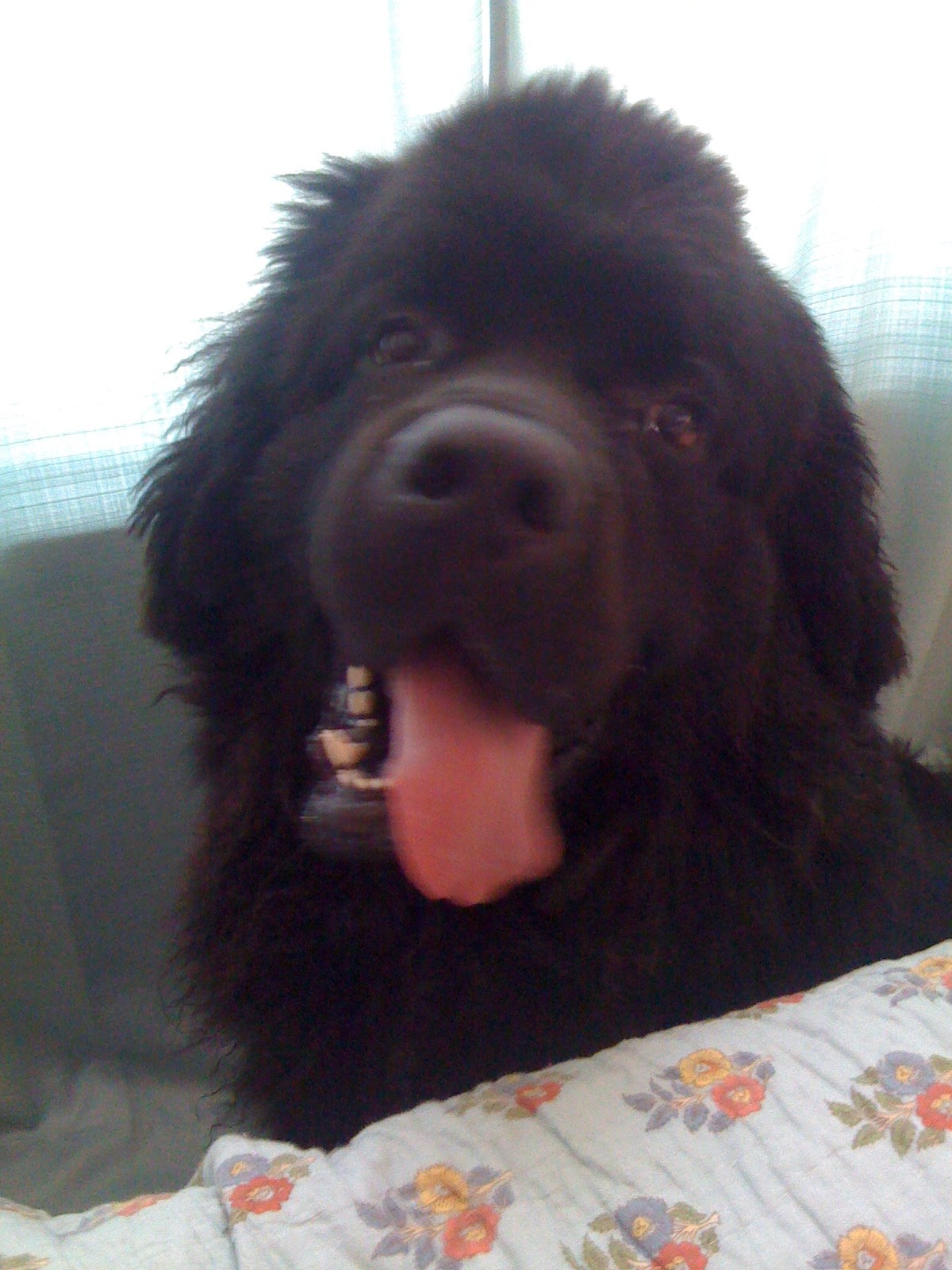
When I wake up every morning, I adjust my blanket and reposition my floppy arms before slowly opening my sleepy eyes to see this:
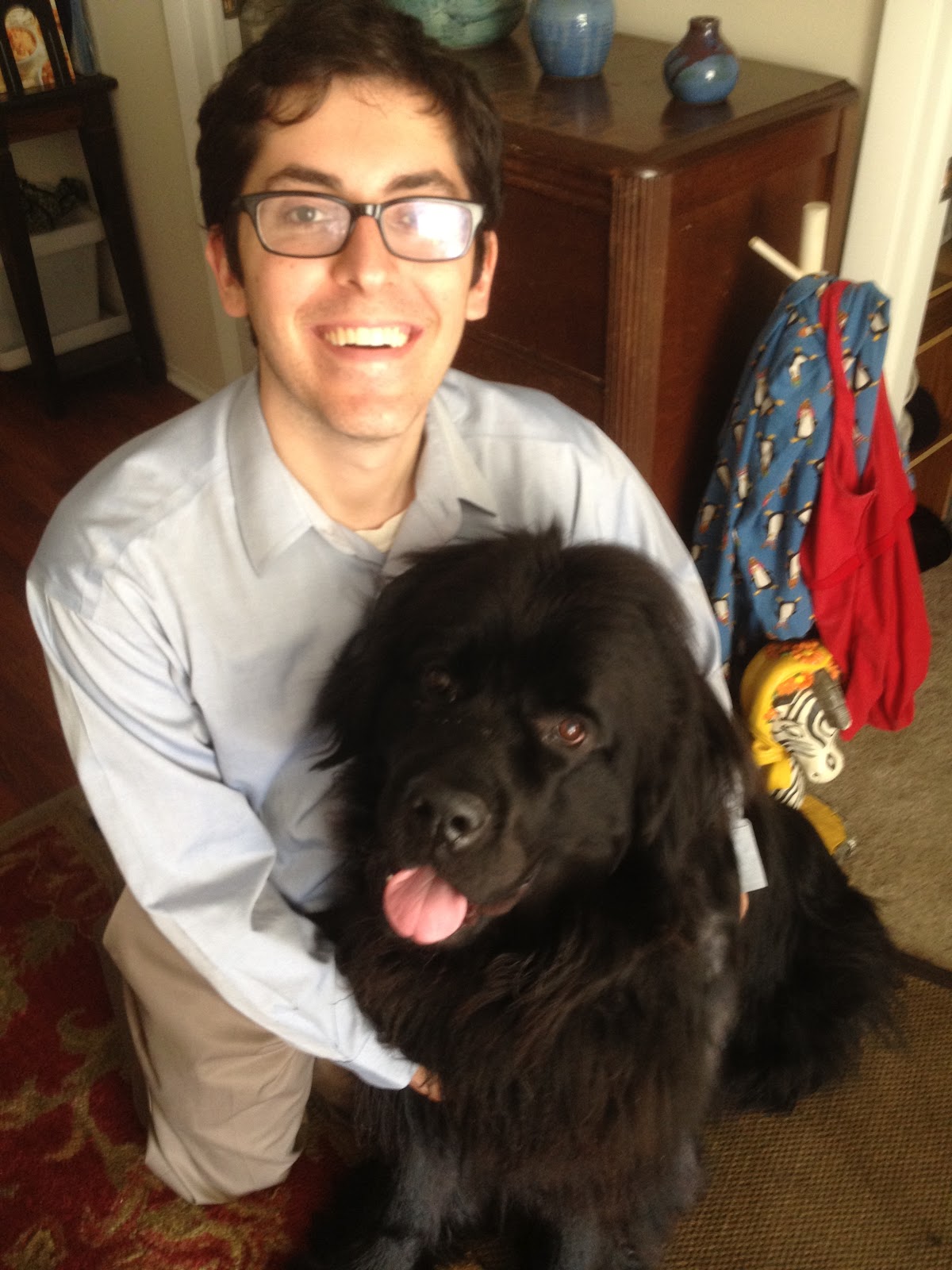
That’s my dog, Teddy, giving me his “Good morning, time for breakfast!” stare. He’s a 10-month-old, 105 pound Newfoundland puppy with a personality as cozy and huggable as his fluffy body. And he wants me to let you know that he would love to meet you.
If he wasn’t a dog, his morning stare would creep me out. It did initially: the first time he woke me up this way I found it so jarring that I jerked my head back onto Ian’s pillow because his huge head was only six inches away from my face. Even today I never know if he’s been there for two minutes or two hours.
But now I look forward to seeing my Teddy Bear’s face first thing; it’s just a daily reminder of his immortal cuteness. And, as a recovering omnivore, his stare reminds every morning me why I finally chose Vegetarianism in April 2011.
Before then, I had always called myself an “aspirational vegetarian.” I had read lots of articles on the health benefits of plant-based diets and seen several documentaries on the ethical and environmental implications of the meat industry and had even gone through a few day/week-long stints of meatlessness since college. But I shoved all that info behind my conscience whenever I stared at the delicious mushroom-swiss burger on Chili’s menu or smelled bacon crisping in the frying pan. There’s no denying it: meat is tasty.
We adopted Teddy in December 2010, and four months later we saw Food, Inc. All I’m going to say is that if you eat food in America, you should see this movie. I don’t remember many of the facts or persuasive arguments in the film, but I remember seeing the image of a black cow standing in a stockyard.
Then I looked down at Teddy who was also watching the movie (he likes TV), and he looked back at me and smiled. That was it. They looked too much alike. I knew I’d no longer be able to eat a hamburger without seeing Teddy’s face in it. So I’ve been a vegetarian for four months now. I realize that doesn’t sound like much time, but it’s significant to me because I know it’s the real thing. Having failed before, I know what it feels like to know you’re going to give up, and I don’t feel like that anymore.
So Teddy is the carnivore that finally made me a vegetarian. Even though he eats meat and has his own environmental impact, he’s helping me improve my own ecological footprint, and he’s converted me in the most significant way. You see, as much as I care about the environmental consequences of meat production, I couldn’t stop eating meat because it pollutes our water and deforests our land. I stopped eating animals because I started loving one, and I can’t eat something I could love.
Thursday, July 7, 2011
The Squat Pen Rests
"The squat pen rests"
Those are the most popular words in the most popular poem of a popular - and decorated - contemporary Irish poet.
I first read Seamus Heaney's poem, Digging, in a British and Irish poetry class in college, which I took to fulfill my literature requirement mainly because I thought that a poetry class would have a light reading load. (It did.) Lucky me, I liked the class. So much so that **Nerd Alert** I even got misty-eyed reading Do Not Go Gently Into That Good Night by Dylan Thomas.
Digging didn't make me cry, but love rarely should, and I do love this poem, as evidenced by my musings about it here seven years later. In fact, I almost named this blog The Squat Pan Rests because it so strongly resonates with me and my decision to become a housewife. Above all, Digging is a universal anthem to do-what-you-love that touches on our insecurities about the choices we make and ultimately celebrates the determination to persevere in the face of doubt.
Born into an Irish farming family in 1939, Seamus Heaney left his agricultural roots in Northern Ireland to become a poet and one of the most celebrated writers of the 20th century. He even has his face on an Irish stamp.
My face is only on Facebook, and my biggest professional accomplishment of late was getting a sauce stain out of polo shirt.
But my decision to become a housewife mirrors Heaney's decision to become a poet. He may be famous now, but Digging reflects a simpler time when Seamus was just a young man choosing poetry over farming and struggling against the weight of predetermination to choose a new life for himself. It is a poignant tale of the poet's family roots and his reverent determination to change courses. I recognize his emotions and sympathize with his insecurities - the what-if's and what-will-my-family-think's that infuse specks of uncertainty into an otherwise solid decision. Heaney now has the benefit of retrospection and public accolade to assuage his insecurities. But right now it's just me and my hopes that I'm doing the right thing.
Fighting against those hopes are the struggles and accomplishments of previous generations that most often infuse my mind with doubt. Sometimes being a homemaker feels like I'm standing in front of Susan B. Anthony telling her why I'm not going to vote in the next election. But like the poet, who has great reverence for his forefathers' accomplishments farming the land - and perhaps a slight melancholy at not wanting to follow their path - so do I have the deepest admiration for the trailblazers before me. The Rosie-the-Riveters, the Peggy Olsons, the Working Girls, "But I've no spade to follow men like them". I'm choosing something else.
Thank you, Mr. Heaney, for reminding me that the right choice is the one you pursue with confidence.
Digging
Between my finger and my thumb
The squat pen rests; snug as a gun.
Under my window, a clean rasping sound
When the spade sinks into gravelly ground:
My father, digging. I look down
Till his straining rump among the flowerbeds
Bends low, comes up twenty years away
Stooping in rhythm through potato drills
Where he was digging.
The coarse boot nestled on the lug, the shaft
Against the inside knee was levered firmly.
He rooted out tall tops, buried the bright edge deep
To scatter new potatoes that we picked,
Loving their cool hardness in our hands.
By God, the old man could handle a spade.
Just like his old man.
My grandfather cut more turf in a day
Than any other man on Toner’s bog.
Once I carried him milk in a bottle
Corked sloppily with paper. He straightened up
To drink it, then fell to right away
Nicking and slicing neatly, heaving sods
Over his shoulder, going down and down
For the good turf. Digging.
The cold smell of potato mould, the squelch and slap
Of soggy peat, the curt cuts of an edge
Through living roots awaken in my head.
But I’ve no spade to follow men like them.
Between my finger and my thumb
The squat pen rests.
I’ll dig with it
Subscribe to:
Posts (Atom)