Monday, May 2, 2016

Dear Aunt Pat

Dear Aunt Pat,

All of your family and friends gathered for a cookout on a warm day in Cincinnati yesterday to celebrate your life. When it was my turn to speak, this is what I said. I'm leaving it here for you because you've always been so supportive of my writing. I assume you have internet in heaven because that's where Netflix came from.

Love,
Annie

On the evening of April 11th, my son was running around naked after his bath (“Air drying” as we like to call it) when I got a text from my dad. The worst kind of text; the one that we all started to receive that evening. My dear Aunt Pat had passed away.

It’s odd how something so expected can still muster such a gut punch.

Still in the midst of our nightly bedtime routine I put a diaper and jammies on my little guy and mindlessly grabbed a story off the bookshelf. It turns out that I picked a gargantuanly stupid book to read that evening. On the Night You Were Born opens like this:

On the night you were born
The moon smiled with such wonder
That the stars peeked in to see you
And the night wind whispered, “Life will never be the same”
Because there had never been anyone like you… Ever in the world.”

My husband had to read the bedtime story that night.

But how perfect is that message for today? Today is not about the evening of April 11th. No, we’re having a beautiful cookout and wearing bright colors because today is about July 20th, 1956. Younger or older that day, near or far, or maybe not even born yet, July 20th is the day that blessed all of our lives.

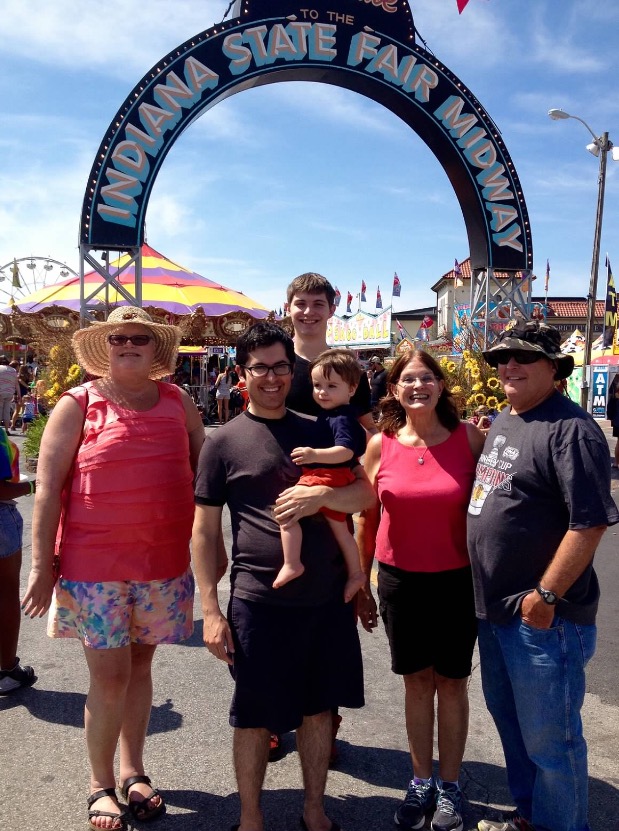
Generous, spirited, vibrant, caring, fun… My Aunt Pat was the best parts of humanity, rolled into one human being. She was endlessly, selflessly supportive. Aunt Pat drove in from out of town hours before my high school orchestra concerts. She took me on my first trip to Disney World, and she offered up the pullout couch at her timeshare when we wanted to go on vacation. She planned our baby shower, drove to Chicago for that baby’s first birthday party, and made a quilt decorated with farm animals to commemorate his first trip to the Indiana State Fair. Aunt Pat sent me a box of craft materials when I started scrapbooking; she read food labels for me at Costco when I eliminated gluten; she invited us to a Reds game when she found out my new boyfriend liked baseball; and when I married that boy a few years later, she is still the one everyone remembers from the dance floor at our wedding.

My father-in-law said it best. A few months after he first met her, I mentioned her in a conversation and said, “You remember Aunt Pat, right?” To which he responded, “Aunt Pat? How could I forget Aunt Pat?”

How could I forget Aunt Pat? Those six words are as true today as they have always been: “How’s your Aunt Pat?” has been a common question throughout my whole life, especially after her diagnosis in 2010. But even when she was sick, the answer was always, puzzlingly, the same: “She’s great.” In her persistence - her insistence - to live her whole life to its truest potential, she was a constant reminder to live the good life: That in the face of sickness or doubt or heartbreak, we must always choose happiness. July 20th, 1956 lit a light too bright for even cancer to fade.

Aunt Pat’s positivity in the face of her illness reminded me of a little story I read in Tuesdays With Morrie:

The story is about a little wave, bobbing along in the ocean, having a grand old time. He’s enjoying the wind and the fresh air — until he notices the other waves in front of him, crashing against the shore.”
'My God, this is terrible,’ the wave says ‘Look what’s going to happen to me!'
Then along comes another wave. It sees the first wave, looking grim, and it says to him, ‘Why do you look so sad?’
The first wave says, ‘You don’t understand! We’re all going to crash! All of us waves are going to be nothing! Isn’t it terrible?’
The second wave says, ‘No, you don’t understand. You’re not a wave, you’re part of the ocean.’
Aunt Pat has always been my second wave. And we are all so lucky to have shared the same ocean with her. She was special in ways that now seem so difficult to qualify. Reducing her to adjectives feels like trying to describe an inside joke, or a movie plot line, or the taste of chocolate: it's just best experienced first-hand.

Of course, as we all know, no quality defined Aunt Pat more than her love for Max. In fact, one of my earlier memories from my childhood is of a conversation I had with her shortly after Max was born. I was ten years old, riding in the passenger seat of her little dark blue Toyota, and she was talking to me with maturity and trust, as she always did, like a friend. Then she started talking about baby Max. I remember this conversation almost verbatim: She said to me, “You know, when you were born, your parents would say to me, ‘We really love her.’ And I would look at them and say, ‘I know, I know, she’s cute; I love her, too.’ But now I have Max, and I do. I really, really love him.” I wouldn’t have my own child for another two decades, but that day in 1995, I understood the depth of a mother’s love for her son.

So when I said goodbye to my Aunt Pat for the last time a few weeks ago, she said to me, “Just love Max.” “I already do,” I said. That’s the thing: Max, you are so much like your mom: generous, spirited, vibrant, caring, and fun. But most of all, just like her, you are so incredibly easy to love.

A few weeks ago, I tucked my son into bed with his farm animal quilt, and my husband finished the story. Here’s to July 20th, on the night my Aunt Pat was born.

For never before in story or rhyme (not even once upon a time)
Has the world ever known a you, my friend,
And it never will, not ever again.
Heaven blew every trumpet
And played every horn
On the wonderful, marvelous
Night you were born.

Sunday, October 18, 2015

A Letter To My Past Self

Dear Me In 2012,

You are two years into your marriage and people are starting to ask when you and Ian are going to have children. You're wondering the same thing, but you're nervous about how a child would encumber your lives. You think that "having children is the denoument of the slide into adulthood known as 'settling down.'" You're worried you'll regret it.

I'm writing to you from three years in your future. You have a 17-month old. You have stretchmarks and a scar on your belly, pediatrician's bills in your filing cabinet, and an early wakeup call everyday. And you have no idea how you could have ever thought you would regret this.

You're worried about parenthood limiting your wanderlust. No more chats about spending three weeks in Munich or joining the Peace Corps. As of today, your passport has been expired for three years and your fear of flying has little to do with turbulence, and more to do with flying with a cranky baby. (And a carseat. By yourself. True Story.) You like traveling less than you used to. You feel lucky to love being at home.

Plus, you get to visit the remote island nation of James everyday, which is more exotic than any place you've ever pinned on Pinterest. The unique inhabitant of this island has weird customs like throwing food, waking at odd hours, and shrieking at the slightest sensation of any emotion whatsoever. Jamesland is fascinating.

I wish that you would redirect your concerns about world exploration to your friendships because having a baby is going to be a huge shock to all of the relationships in your life. Happily, you are going to make some amazing new friends through James. Nascent as these friendships may be today, when you watch James swing in tandem with a music class friend or steal cheerios from a toddler whose mom you met in birth class, you will silently hope that you'll get to watch these babies grow up together. 

But having a baby will be also be an unexpected test on your old friendships. Getting pregnant at 28 means that, of all the friends in your wedding photos, you and Ian will be the first ones to become parents, and that's tough sometimes. You'll feel guilty when you realize it's been two months since you reached out to a friend, when it feels like it's been two weeks. You'll feel isolated when your girlfriends can't sympathize with your frustration at a woman who complained to you about her coworkers leaving work at 5:30 to pick up their kids from daycare when "I have a yoga class at 5:30!"

And you'll feel sad for the friends you start to lose touch with. The initial phone calls of excitement give way to fewer get-togethers and unanswered texts. You'll hope that they still think of you as the same person that you were before James. But your schedule and priorities are different now, so perhaps they think you've changed. They're not wrong.

Most of all you'll feel grateful for your friends. They will bring you doughnuts in the hospital and Chipotle in those bleary first few weeks home; and they'll buy James books and onesies and ask to hold him even though "I don't know what I'm doing!"; and they will still invite you and Ian out to dinner, even though they know you need way more forewarning nowadays. You'll hope that you will someday get to repay the tremendous kindness that your friends have shown you, and you'll want to thank them in a blog post for making you feel like the same version of yourself even in the middle of a huge life change.

Of course, you hate change; you love routine. You've always been a "love-you-have-a-good-day" kind of gal. So introducing precious sweet 8lbs 15 oz angel baby James into your life is going to S-U-C-K at first. But, as it turns out, babies love routine, too. So you'll find your groove again right away, and you'll find comfort in the 7pm bath-book-boob-bed routine with James and the quiet time on the couch with Ian every evening.

Other things will change, too. You'll be more self confident. You won't mind your stretchmarks because of the miracle they represent. Your marriage will get stronger and, the biggest surprise of them all: you'll have better sex, likely for a few reasons: because you're more confident; because you appreciate alone time with your husband like never before; and because nothing's quite a sexy as seeing the man you love jump out from behind the couch just to make the little boy you love laugh.

In the months before James' birth, someone close to you will tell you that it's totally normal to bring him home from the hopsital and think, "I've made a huge mistake." That happens. You will look at your days-old bundle of joy, swaddled in those adorable Aden & Anais muslin blankets, perfectly asleep in his crib, and you will see him as a ticking time bomb that will explode into a fit of wailing five minutes after you've dozed off. You'll dread the possibility of him getting sick because then he might really cry non-stop.

After a couple of weeks, you'll reflect on those thoughts and newly believe that there is nothing powerful enough in this world that could keep you from being the one to comfort James if he ever got sick. Your love for him will be the most beautiful, primal feeling you've ever experienced, completely unparalleled in your life.

In thinking about having children, you hypothesized that "when you sacrifice for love... it just feels like the right decision." You're not wrong, but those words don't sound right to me anymore:

Parenting James isn't a sacrifice; it's a blessing.

When I'm rocking James to sleep in the evening, and I look at his peaceful face as the shadows roll back and forth across his soft cheeks, I think about Time. God willing, my baby will grow old one day, and Time will crease those cheeks with wrinkles and stiffen the little fingers resting sweetly on my chest. When he's old and gray and I'm not there, will someone rock him gently? Will they comfort him when he can't sleep, and stroke his hair tenderly, and pull his blanket up to keep him warm? In those moments, I'm reminded that the real sacrifice in parenthood is the beautiful fragility in wondering if anyone could ever love James as much as I do.


Saturday, September 13, 2014

Thoughts on a C-Section

When James wakes up from his nap, I’m going to give him a big kiss on his chubby cheeks and place him snug on my hips. My big ole’ birthing hips. Except those hips didn’t birth him. He came out of a 7-inch incision on the underside of my belly. I see that scar everytime I take my clothes off, a reminder of the happiest day in May when I became a mother. But, for some reason, lately I’ve been looking at that scar and wondering one question: what went wrong?

Of course, in the most important sense, nothing went wrong. I was pregnant in the 21st century and gave birth in a stellar hospital, under the care of wonderful nurses and physicians, coached by our incredible doula, in a country with a low maternal mortality rate. When my water broke at home without any sign of labor and baby’s risk of infection went up because his bag of waters was no longer protecting him, those nurses hooked me up to pitocin to start labor for me. And after kickin’ it the old-fashioned way for 22 hours, I got to labor without pain thanks to the guardian angel anesthesiologist who administered my epidural. And when my cervix refused to dilate past 4.5 cm, and I’d been on high levels of pitocin for too long, that wonderful team of doctors cut James out of my belly safely for the two of us, and I became part of the 30% of women who give birth via C-Section every year in the US.

That’s a substantial number, but I naively thought I would never be included in it. I had a very easy, healthy pregnancy and thus had the luxury of casually ignoring the possibility that I would deliver James via C-Section. Some mamas aren’t so lucky: risk factors like breech position and placenta issues often require a planned-for, scheduled surgery. But that wasn’t me. On top of my healthy pregnancy, I went to yoga classes and on daily walks, I took prenatal vitamins and ate well(-ish), I read pregnancy books, and Ian and I signed up for a 9-week long childbirth education class. Ending my pregnancy with a C-Section felt like being carried across the finish line when I had been training to run a marathon.

Moreover, as I prepared for a "natural" childbirth in the months leading up to our due date, all l I kept hearing was how women’s bodies are designed to birth their babies. And I couldn’t help but look at my own body in the mirror, with my big hips, big boobs and soft tummy, that I looked like a woman designed to push a baby out of her hoo-ha.

With the benefit of hindsight, I wish that I would have forced myself to envision James’ birth in different ways rather than believing that my birth plan would come to fruition if I wanted it hard enough.

That I didn’t mentally prepare for a C-Section has led to a bit of retrospective mourning for the birth I thought I was going to have, something scheduled C-Section mamas get to grapple with weeks ahead of time. Instead, after a whole day in labor with no sleep, the surgery team flooded our labor & delivery room and I had no time or energy to reconcile my emotions. I was left feeling like I missed out on something: the pushing, the baby on the chest, seeing my husband’s wide smile instead of trying to decipher it behind a surgical mask…

Most of all, I’m scared that James missed out on something, that being born through my abdomen will disadvantage him somehow. And that he’s disadvantaged not because of some unlucky pregnancy issue, but because of the decisions I made that precipitated his cesarean delivery. He wasn't breech and my placenta was fine, so I can't help but blame my own choices. If only I had waited longer for labor to start on its own, or asked about Cervadil at that last prenatal visit when I was past my due date, or used my birthing ball more… Maybe I didn’t just fail to have a vaginal birth; maybe I failed him.

But in the face of this doubt, I am certain of one thing: my C-Section was the right decision under the circumstances at the time. So perhaps James’ birth was my first big lesson in parenting: all Ian and I can do is make the best decisions we can with the information that we have. That’s what we did. As our childbirth education instructor told us, “As long as you love your baby, you’re making the right choice.” I love my sweet baby more than any words I could write here, and the choices we made on his birthday - being induced to avoid infection and opting for the C-Section to stop his prolonged exposure to pitocin - we made of out love.

I may not have been the first one to hold James in my arms - that was Ian - but I held him in my body for 41 weeks. And I hold him today, his little foot resting sweetly over the scar on my belly, in between my birthing hips.

*Amanda Megan Miller Photography

Wednesday, July 17, 2013

A Preview of Parenting

Several weeks ago I told Ian that we should think about investing some stock in the pet care industry. I had just read an article, Why America’s Falling Birth Rate Is Sensational News for the Pet Industry, which highlighted the trend of us job-hunting, loan-burdened, cohabiting 20-somethings turning to our furry babies to replace human ones. Ian and I very happily fall right into this quasi-parenthood. We bought Teddy health insurance, we buy him vanilla cones at Dairy Queen, we send him to daycare, and we've even taken him to get his picture with Santa.


For us, dog parenting is like real parenting “lite.” We still have responsibility for Teddy’s socialization, for his health care, and for remembering to bring his toys when we travel to “Grandma and Grandpa’s.” But we can still put him in his crate and go to the movies on a whim. And, of course, we love that friggin’ dog with our whole hearts. Even with the shedding, the drool, the vet bills (which, btdubs, I’m starting to think he has better healthcare than us), parenting him has been a blessing in our lives together.

However, dog parenting has given us another glimpse into a really annoying part of real parenting: unsolicited advice.

Let me take you through two scenes we encounter with our big pup all. the. time:

At a new groomer checking out:

Groomer: So, what do you feed Teddy at home?
Me: We feed him Purina Pro Plan for Sensitive Skin & Stomach.
Groomer: Gasp! Oh you know that Purina is not good food for him, right?
Me: Well, we’ve tried him on the really high quality foods - I want to feed him those - but he just doesn’t do well on them.
Groomer: Pulls up list of Pro Plan’s ingredients on computer screen. Well I just have to show you this. This ingredient is a byproduct of the brewing industry, this is a preservative...this isn’t hormone-free organic meat from Mount Sinai...

Everyday this week, walking in the shade in front of our building or at night:

Passerby 1: Your dog looks really hot.
Passerby 2: Your dog looks really hot.
Passerby 3: Your dog looks really hot.
Passerby 4: Your dog looks really hot.
...

In these two instances, these folks usually have the correct intentions. In fact, when people comment on Teddy being hot, it’s often observational (“Wow, he must be hot today!”). But it's the critical comments that make me want to get snippy. The wrong words or the wrong tone implies that we’re bad dog parents because he looks hot. Even though they don’t know that we live RIGHT ACROSS THE STREET.

And boy did I almost lose my cool at a critical comment last night. Ian and I were coming in with Teddy after his nighttime walk when two ladies asked us to hold the elevator for them. We did. I even pushed their floor button for them because they were carrying lawn chairs. One of the women narrowed her eyes, tilted her head in judgement, and asked us in a slow, drawn-out question:

"How can you liiiive with a dog like that in this building?"

In spite of her tone, I responded politely: “Well, Newfies are actually pretty good apartment dogs because they’re so lazy. He’s just a big floor potato.”

“Oh, alright.”

Our elevator stopped at our floor, so I loosened my tongue a bit as we stepped out: “... And, you know, there's the fact that we love him. We’re not going to get rid of him.”

The doors closed behind us, and I turned to Ian to say what I really thought: “Bitch.”

More than any fact about Teddy’s life, that he is big and lives in an apartment with us draws the strongest criticism. These particular commenters might think they have my dog's best interests at heart, like the food-mongers and the heat-observers, but they do not. Nevermind that Teddy is not a goldfish. Nevermind that we did, in fact, live in the suburbs with him and even with the big spaces and backyards, he still missed the city. Nevermind that he is a floor potato and, as I type these words, he is engaging in one of his all-time favorite activities: sleeping on the tile by the fireplace.

No, this line of thinking - that only small dogs can live in smaller spaces - is dangerous. As an animal shelter volunteer, I see dogs relinquished because their humans are moving to different spaces. I hear adopters come in and say to me, “I’m looking for a dog, but only a small one because I live in an apartment.” And then I see the shih tzus and poodle mixes adopted the same day they arrive on the adoption floor, while the shepherds and pit bull mixes, cursed only by their size, wait and wait and wait for someone who knows what Ian and I have known all along: dogs don't care about the size of your house, but the size of your heart.

When we got Teddy, we thought he would fit well into our lives. Little did we know that, two years later, we gladly fit into his. I bet it’s the same with real parenting, too.

Wednesday, July 3, 2013

Biting My Tongue, Part 2

Over the past few years I’ve dined at Italian restaurants with a few family members who, of the plethora of menu options available, have ordered the veal parmesan. Now, I’m not saying you shouldn't eat veal parmesan; I’m sure it’s very tasty, and to each his own blah blah blah... But, like gifting Turkish delights to an Armenian, or eating bacon-wrapped cheese curds in front of a devout Jewish person, picking the baby cow off the menu in front of a vegetarian makes me do a little mental head tilt of confusion. It’s just a little... weird?

As much as I enjoy a good debate about the morality of meat-eating, I usually bite my tongue about others’ meals because nobody, especially vegetarian ole’ me, likes for their food choices to be the center of conversation. Even when the subject of my vegetarianism does come up, I try to be polite and never engage in a Wollenian style takedown of others’ carnism.

But the biggest reason I stay mum at the dinner table is because militancy - whether about gun rights, immigration, abortion, or calves being tethered into immobility - rarely works. At least not with friends and family.

As anyone who cares deeply about any issue knows, we impassioned folk have a choice to make everyday: to be outspoken about the wrongs that bother us, or to sit back quietly and lead by example. I think the latter works better in the long-run because, as much as we define ourselves by what we are, we also define ourselves by what we are not. The Other is just as much a part of our identities as The Self, so every time we say/tweet/post something divisive, we may harden the juxtaposition of opposing opinions.

Here’s what I mean:
  • I am a woman; I am American; I like Coke; I am a Chicagoan; I am a vegetarian
  • I’m not a man; I’m not an Afghani; I don’t prefer Pepsi; I’m not a New Yorker; I don't eat meat

So every time you say something about being a man; it reinforces my womanhood. Every time someone in suburbia posts about their 2nd Amendment rights, it reminds me that I’m a Chicagoan who hates gun violence. Everytime I share a video about overfishing or ag-gag laws, I’m forcing people to identify themselves at meat-eaters.

In other words, sharing strong opinions cultivates defensiveness. We think that the rightness of our own beliefs will entice people to step over to our side, but it usually makes people take big steps away from us. So, as much as I love the chance to correct someone who thinks that the milk in their fridge comes from a farm like Dotty and Kit’s in A League of Their Own, I try my best to stay mum on the subject of modern-day animal agriculture because, if I push my points to strongly, I’m going to push people away.

Perhaps the most persuasive action is a quiet, kind patience.

Take my cousin, Emma, for example - a lifelong vegetarian who gave up meat as soon as she learned who it came from. When I started thinking about transitioning to a meat-free diet, I naturally thought of her. But I didn’t think of her Tofurky or her leatherless shoes. Rather, I thought of her kindness and her patience with the rest of us; her constant acceptance of our different food choices. She was the quiet vegetarian who never made me feel guilty for eating turkey at the holidays or having down feathers in my winter coat.

And that’s the thing: when people hear the word “vegetarian,” I don’t want them to think of me. Or if they do, let it be with the kindness with which I always thought of Emma. Let my presence as a plant-eater in others’ lives be but a brief respite in their minds before going on to ponder the real substance of the word.

Militant vegetarians - or environmentalists, or Tea Partiers - do their cause a disservice. Combativeness should stay in the town hall or on the streets in protest, but not at the dinner table because - and this is the the truth that makes me bite my tongue every time a family member orders the veal - had I ever been made to feel guilty by a vegetarian, I probably wouldn't be one today.

I made the transition, and now there are two vegetarians at our family gatherings. Last Thanksgiving, Emma and I sat together at the far end of the table, happily plopping vegan stuffing and butter-free mashed potatoes on our plates while handing off the turkey slices and corn casserole to those around us. Then, at our most recent family gathering a few weeks ago, the turkey master himself, my grandpa, gladly scooped up a slice of of our vegan dish for the first time ever. A vegetable pot pie. He really liked it.


Tuesday, July 2, 2013

Biting My Tongue, Part 1


I’m a vegetarian, an almost-vegan these days (How you doin’ oatmeal chocolate chip cookies from Potbelly?). I’m a shy vegetarian, though - not because I’m ashamed or embarrassed, but because I realize what a lightning rod the word “vegetarian” can be.

Case in point: I was at a friend’s potluck a few months ago. I brought my vegan mac ‘n cheese, which everyone seemed to like even before they knew what was in it. Eventually someone mentioned the lack of dairy in my dish, and then this guy meandered over to me and said: “So you’re a vegan? You know that cows want to be milked, right?”

Game on.

Whenever somebody starts to defend modern animal agriculture I get a little tickle of excitement in my gut because I loves me a good debate about the merits of vegetarianism. Seriously, I have several vegan cookbooks in my pantry; I attended a seminar with the founder of Farm Sanctuary and summarily adopted (symbolically, of course) one of their goats for Christmas; I subscribe to at least a dozen farm animal protection groups on Facebook; and I’m hoping to some day memorize this epic speech by Australian Philanthropist Philip Wollen in a debate called “Animals Should Be Taken Off the Menu":


So bring. it. on.

But, I had just met this guy, so I bit my tongue and responded diplomatically, “That’s just not true, but we don’t have to get into all of that right now. Tell me more about where you grew up?”

Deep down, I love when people want to talk to me about vegetarianism. That you care about where your food comes from, even if you disagree with me, makes me smile on the inside.

But I stay mum on the outside. I usually bite my tongue at these kinds of provocations because I never want people to feel like I’m different from them because of my food choices. That’s a very common complaint about vegetarians, isn’t it? That we think of ourselves as “better” than meat eaters. However, I think this defensiveness quietly asserts the opposite. Slaughtering animals for human consumption has been and always will be a violent, guilt-inducing act, especially nowadays. We all cringe at undercover PETA videos, and free-range eggs and organic meats have a growing market share because, deep down, everyone cares about animal welfare. We are all compassionate; we are all “better.” As a vegetarian, I may be more consistent with my values, but my values match yours. We are the same.

The biggest reason I bite my tongue at questions about my food choices is because I’m starting to realize how divergent opinions can reinforce each other. I leave my vegetarian dish to do the talking for me at the dinner table because the best way to get people to eat less meat might be to stop trying to convince them. I'll explore that idea in my next post.

Friday, June 28, 2013

The F Word: Wedding Edition

The “I am incomplete until I am thinner” message is a powerful one. Its ubiquity is so absurd that I sometimes wonder how any of us with BMIs over 20 manage to maintain a healthy self esteem. The Thindustry usually blends into the background of my everyday life - a diet pill ad here, a liposuction radio spot there - in a way that doesn’t usually catch my attention.

But I felt bombarded by the fear of Fat at a particular time in my life: during my engagement to Ian. Sure, I saw a few weight loss articles in bridal magazines and the targeted ads on Facebook. Yet, the most significant source of the Thin = Better messages I heard during the months leading up to our wedding was a group I never expected: my loved ones. No matter how important the occasion, it always hurts to hear the ones you love hate on themselves.

Let me be clear: nobody ever told me I should lose weight before my wedding day. Rather, for several of my family and friends, the wedding seemed to act like a catalyst for their otherwise-suppressed weight loss desires. It seemed like everyone close to us followed their congratulations with a brief calculation of how many months they had to lose x amount of weight.

Fortunately, I had a cop-out from this pressure: my wedding dress. I ordered my pretty ivory gown in a size 14, nine months before our big day, so it was imperative that I not lose weight, lest I want to pay beaucoup bucks for alterations on that lacey waistline. Yet, I kept hearing my loved ones malign their own lb’s throughout the wedding planning process. At one point, I felt so overwhelmed by the weight-loss efforts around me that I became a little paranoid about their intentions. Wondering if they were trying to make a subtle suggestion, I asked my bridesmaid sadly, “Am I supposed to be trying to lose weight?”

She reassured me of their intentions, and I got over it. July 10th arrived, I was at my normal weight, and I felt very pretty.


I’ll remember my engagement and my wedding day mostly for the obvious joyous reasons. But that time also sticks with me for a less pleasant one: it brought into stark contrast the beauty I see in my loved ones against their own body images. Faceless bureaucrats telling me I’m fat hurts; hearing my loved ones embrace those awful messages hurts even more.

At the end of the day, we should all try our darndest to see ourselves the way our loved ones see us. Let’s be our own Mark Darcy from Bridget Jones's Diary:

Mark: But the thing is, uhm, what I'm trying to say, very inarticulately, is that, uhm, in fact, perhaps despite appearances, I like you. Very much.
Bridget: Apart from the smoking and the drinking and the vulgar mother and the verbal diarrhea...
Mark: No, I like you very much. Just as you are.


Our third anniversary is coming up, and I look forward to reminiscing about the love we felt that sunny day in July. Most of all, I remember everyone looking like the best versions of themselves, but not because they were dressed up, or were wearing fancy makeup, or had lost weight. Our wedding guests looked beautiful because their faces were lit up with happiness. I’ll take happiness over dress size any day of the year; it looks good on everyone.

Thursday, June 27, 2013

The F Word

Ian and I hosted a housewarming at our new condo on Saturday. Expecting upwards of 25 people to attend, I decided to buy two dozen Do-Rite Donuts for a fun, local dessert. This turned out to be a GROSS OVERESTIMATE because my dear friends ate only 17 of the 24. So, left to my own devices, I ate four old-fashioned donuts in 36 hours over the weekend. Maybe it was five. Whatever. I just know that by Sunday evening I was wearing my stretchy pajama pants because I felt bloated and fat.

But, if I’m honest with myself, I’ve felt fat since 3rd grade.

I had a chubby little tummy by the time I was 8, which is when I started to revere thinness. I bragged to my parents about my meager accomplishments on our now-dusty treadmill; I squealed with glee in the dressing room of Abercombie & Fitch when, once during junior high, I fit into a size 8 pair of green cargo pants; and I hugged my high school boyfriend when, after a day of “feeling fat”, he put one hand on my back and one of my stomach to physically show me that I wasn’t. As a dutiful, nice American girl, I grew up fearing the power of the F word: you could call me stupid, you could call me a bitch, but whatever you do, please don’t ever call me fat.


Nothing has changed. I’m a 28 year old woman, but I’m still a nice American girl, and if someone called me fat tomorrow, I might curl up in my bed and cry.

The mirror has always been my biggest critic. In high school, I didn’t think I was thin (I weighed 145 pounds); Freshman year of college I didn’t think I was thin (I weighed 170 pounds); After two semesters in Europe, I didn’t think I was thin (I weighed 150 pounds); A year and a half ago in Indiana, I didn’t think I was thin (I weighed 180 pounds); today, I don’t think I’m thin (I weigh 161 pounds).

These days, I could not imagine feeling thin enough until I weigh less than 150 pounds, or at least until I could comfortably zip up the pair of pants I bought in London. But then I must remind myself that I did once make those benchmarks, and I still felt fat.

One day, upon pondering this absurdity, I decided to focus on the deluge of Skinny that usually blends into the white noise of everyday life. For a few hours, I counted the number of Skinnygirl and Special K commericals on Bravo; I studied the Hydroxycut ads in Ok! Magazine; I tuned into the bikini body and baby weight articles online; and I listened to Jennifer Hudson sing to me about "Feeling Good" on Weight Watchers. I even watched the oft-shared Dove Real Beauty Sketches commercial only to hear: “She was thin so you could see her cheekbones. And her chin, it was a nice thin chin.” And “She looks closed off and fatter; sadder, too.”

Then, like slamming a book shut, I tuned it out. In the silence, I laughed a little at the ubiquity of the Thin = Better messages I’d just paid attention to. They were everywhere, obscene in their commonplaceness.

I finally realized that it’s not that I’ve never felt thin; it’s that I’ve never felt fully satisfied with myself. Ever since I became aware of an outside gaze, my body has been a work in progress. In other words, all the Biggest Losers and the Hydroxycuts and the Atkins diets - all of these images have been working in tandem to form a singular, powerful subliminal message that I, and everyone I know has always embraced:

That I am incomplete until I am thinner.

Fuck that.

Tuesday, June 25, 2013

Are Big Cities The New Small Towns?

I miss Mayberry / Sitting on my porch drinking ice cold Cherry Coke / Where everything is black and white / Picking on my six string / People pass by and you call them by their first name / Watching the clouds roll by.
~ Rascal Flatts, "Mayberry"


When we decided to move back to Chicago from Indiana last year, we held kitchen-table talks and drafted several pros and cons lists. We had immensely enjoyed the special times we had spent my family and two of our dear friends who live in Indianapolis. We knew we’d miss them if we moved, and we do today - all the time. There were other pros in our Indiana column, too: the lower cost of living, the parking lots, and the tranquility of the natural environment around us.

Ultimately, though, we just couldn’t shake the heaviest con in my home state’s column: that we felt lonely.

It’s not that we didn’t spend time with our close friends and family there. We did, and we loved it. Rather, we felt lonely because of the suburbs themselves. For us, a childless young couple, they felt insular and quiet.

Of course, I thought it would be different. When we moved to Indiana, I had imagined a Mayberry-type sense of belonging: the smaller the town, the closer the community, right?

Not for us.

People held doors, but didn’t engage in conversation; neighbors pulled their dogs away from ours, instead of stopping to say hello; And no one learned my name in Zumba class for at least two months. It felt like everyone belonged to their own social group - a church, an office, a school, or a playgroup - and we were always on the outside. My mom even paraphrased A Few Good Men to joke about our dog’s boredom in our neighborhood: “Teddy was leaving his apartment for a walk, and he didn’t see a soul, and he didn’t meet a thing.” That was really the crux of our loneliness: we missed walking out our door and seeing people, like we had in the city.

It took moving away from the big city to help us realize what a powerful sense of community urban environments foster. So we moved back, and I’ve renewed my belief that big cities are the new small towns.

As I’ve mused before, I sometimes long for simpler times. I wish I could have been born in a Fried Green Tomatoes kind of era, where everyone knew everyone and people stayed put. In fact, one of my biggest gripes about “the real world” so far has been the stark dichotomy of life during and after college: we transition from a campus life full to the brim of social activity and friendships, to an office life of sitting in lonely cubicles for 9 hours a day, staring at computer screens, Gchatting with friends who are a plane-ride away because we all took jobs in faraway places. I can’t help but wish we all lived closer together, in a simpler time and place.

While cities are hardly simple - especially this one - they do cultivate the most basic form of human communication: face-to-face interaction. These days, we real-life chat with our neighbors in the elevator and learn about their goings-on. We greet our doormen by name, as they do us, and talk about parking tickets and online shopping. We bond with dog-owners as crazy as us in our local dog park. We roll our eyes with our fellow pedestrians at errant bicyclists and honking taxis. And right now, we can hear the shouts of our fellow Blackhawks fans outside our window, and we can’t wait to celebrate with them later.

Big cities force us together, and I can’t help but love mine for it.

Chicago is our new Mayberry, and once the interest rates dropped low enough, we got to buy a little piece of it. "Sweet Home" indeed:


The new digs.
Ian smiling about the Blackhawks win.
Looking into the sunroom
Bathroom. Aka Teddy's room (he loves the cool tile)

Bedroom pics coming soon in a post about our wall art. Teaser: Ian picked out the prints in the bedroom.