Friday, August 24, 2012

Gender & Belonging, Part 1: Women & Belonging

Today I read a Slate article about the pervasive influence Great Lakes cities are having on American vowel sounds. As a Hoosier transplant in Chicago, I recognized the dialects referred to in the piece. I hear them every time I turn on the five o’clock news and hear the voice of a Chicago police officer, government official, or any lawyer involved in the Drew Peterson trial.  But one line at the end of the article piqued my curiosity about dialect adoption:

“While our skin color is often the first and most obvious indicator of our membership in a social group, our dialect is the first outward signal that we consciously influence.”

I started hearing the Chicago dialect regularly when I went to college at a school where 80% of the student body was from the suburbs of the city.  Mid-freshman year, a few of my friends from Indiana and downstate Illinois made an empirical observation: girls from the suburbs tended to be the ones with the strongest Northern accents, not the boys.  (Folks raised in the city most often had an accent.)  

More empirics: my father-in-law and my previous boss were born and raised in the same part of New York City during mid century.  But my boss, a woman, is the one who still calls coffee “cwoh-fee.”  And a dear girlfriend of mine who moved to Texas a few years ago now says “y’all” more than her native-born Texan husband.  It’s adorable.

It's not just me noticing this gender discrepancy.  According to this New York Times article, women do adapt to linguistic changes quickly:

“It’s generally pretty well known that if you identify a sound change in progress, then young people will be leading old people,” said Mark Liberman, a linguist at the University of Pennsylvania, “and women tend to be maybe half a generation ahead of males on average.” Less clear is why. Some linguists suggest that women are more sensitive to social interactions and hence more likely to adopt subtle vocal cues.”

So, does A + B = C : If our dialects are our “first outward symbols” of belonging to a group, and if women adapt more quickly to dialects, then do women have a stronger need to “belong” than men?

From an evolutionary perspective, we all need to feel like we belong to a group.  Banding together and the comfortable feelings of kinship that accompany collective identity have helped ensure the survival of our species.  But maybe women value belonging differently than men.  University of Michigan professor, Bonnie Hagerty, studied college students’ feelings of belonging and concluded that, “being able to say ‘I belong’ is important to the healthy psychological functioning of men, but it is vital to women’s.” She further noted that

“Those who didn’t feel they belonged were more likely to experience depression, anxiety, loneliness, suicidal thoughts and psychiatric treatment. They also were less likely to be involved in community activities. Women, however, experienced the effects of belonging or non-belonging more acutely than men.”

Aside from my empirical dialect theory, plenty of evidence supports this idea that women value belonging to a group more than men:

  • Women are more likely to be religious than men.  According to the US Religious Landscape Survey published by the Pew Forum on Religion and Public Life, “Women in several Christian traditions are more likely than men to attend religious services at least once a week...”
  • Women spend more time on social networking sites like Facebook.  ComScore, a digital marketing company, reported that as of last year, “In North America and Europe, women spent an average of nearly two hours (30 percent) more than men on social networking sites in October.”
  • Can I see a show of hands of women who often act as the social coordinators of their relationship, meaning you organize the get-togethers with friends, you throw and attend birthday parties, and you remind your partners to send appropriately-timed greeting cards?  Oh, is that almost all of you?  I thought so.  The handwriting on the outside of my birthday card envelopes is always from my mom, aunts, or grandma.  
  • Women are held / women hold themselves to easily definable and highly visible standards of belonging. The cosmetics, weight loss, and fashion industries form a multi-billion dollar beauty industry that profits from our insecurities about not fitting in.  Men are subject to these pressures. But with push-up bras, bronzers, and diet pills, women undoubtedly bear a disproportionate burden of this industry’s influence.  

Dr. Roy F. Baumeister of Florida State University summarized women’s need for belonging in an address he made in 2007.  Referencing a Psychology Bulletin article written by S.E. Cross and L. Madsen, he said,

“Men think of themselves based on their unusual traits that set them apart from others, while women’s self-concepts feature things that connect them to others.” (emphasis mine)

So, perhaps women do have a stronger need to belong than men. We plan parties and send birthday cards because we crave deep, meaningful relationships with our friends and loved ones.  In Baumeister’s words, “women specialize in the narrow sphere of intimate relationships [while] men specialize in the larger group.”  

He further notes that social orientation towards the larger group can foster competition for dominance within it: “In large groups, getting to the top can be crucial. The male preference for dominance hierarchies, and the ambitious striving to get to the top, likewise reflect an orientation toward the large group...”

History aside, these conclusions should have some important implications for women’s participation in halls of power, shouldn’t it?  Putting my international relations education to the side and ignoring the “Self” and “Other” concepts ringing loudly between my ears, I can’t help but wonder: If women really do have a stronger need for belonging to a group, whereas men tend to fight for dominance within it, could women perhaps be ideal world leaders?  If women value relational intimacy, might they be able to forge political relationships better than their male counterparts?  

Our current political paradigm has men at the helm.  Even with all our world troubles, I’m going to give men a solid B+  in running things over the past few millennia because I’m starting to feel kinda bad for them.  As I’ll explore in Parts 2 and 3, men’s large-group social orientation comes with big rewards, but even bigger costs.   

Thursday, August 23, 2012

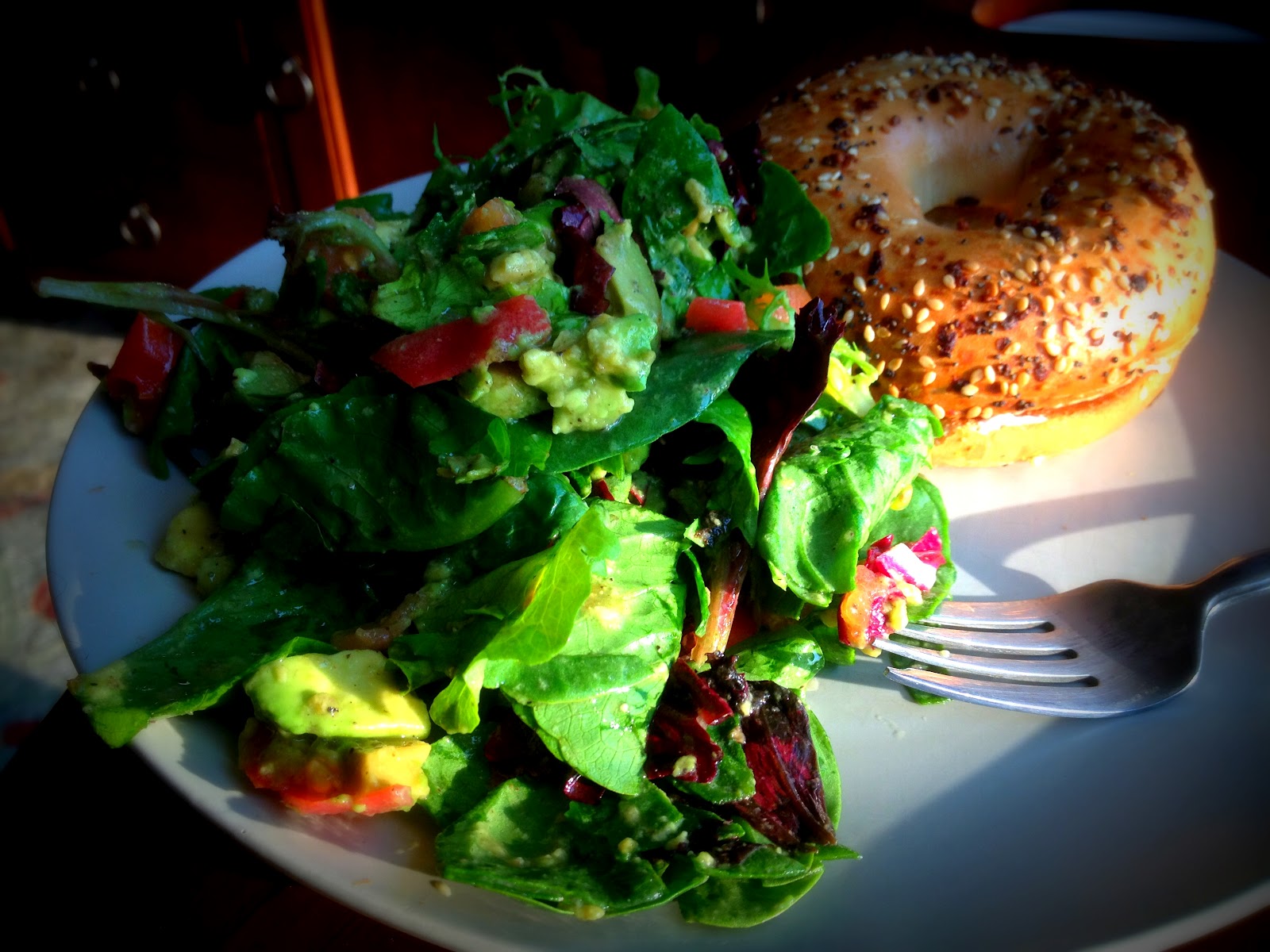
Guacamole Salad

Recipe below

Sometimes I'm nervous to call myself a vegan. In fact, I have a big confession to make: in the past year I have eaten four glazed donuts, two butter-laced pancakes, and a bite of cow's milk ice cream. But I'm grasping my vegan card with an iron fist because I eschew animal products 99% of the time. As Colleen Patrick-Goudreau once said, "Veganism is not about perfection; it's about intention." In other words, gimme a break.

But my epicurean sins are not the reason I bite my tongue in front of waiters. I hesitate to identify as a vegan because, frankly, I'm afraid they won't believe me. You see, according books like Skinny Bitch, vegans are supposed to be runway-model thin. The big names in veganism - Patrick-Goudreau, Kathy Freston, Ellen and Portia DeGeneres - are all quite slim. I've definitely lost a bit of weight since converting, but I am neither skinny, nor a bitch, a fact a playfully pointed out to my mom when when we were back in Indiana visiting my parents two weeks ago. Ever the concerned mother, she was worried that she didn't have anything vegan for me in the kitchen (she did):

"Sweetie, I just want to make sure you're getting enough to eat."

I grabbed my belly and laughed, "Does it look like I'm not getting enough to eat?"

I eat 2000 calories a day of tasty food and am proud to be an immutable example that it is possible to indulge on a vegan diet.

I'm pretty sure all that cute belly pudge I shook at my mom comes from one dietary source: avocados (...and peanut butter...and chocolate). I love that mushy fruit so much that I put on my pasta, on my potatoes, and I'd spread guacamole on my breakfast toast if that wasn't weird.

I've even discovered a way to make a delicious guacamole-like salad. With no added oils and only 4 primary ingredients, this salad is so easy, so quick to prepare, and so tasty. Suffice it to say that if the Muppet's Christmas Carol fruits were talking about me, they'd sing: "If she became a flavor you can bet she would be guacamole."

Guacamole Salad
A big bowl of salad greens (1 serving)
1 avocado, peeled and chopped
1 tomato, diced
2-3 Tablespoons rice vinegar
salt and pepper to taste

Add ingredients to large bowl. Mash avocado with spoon or hands until salad leaves are coated.

Tuesday, August 14, 2012

Father Time

In the darkness of our little bedroom a few nights ago, Ian had one of his hands wrapped cozily around his pillow, and the other around my waist.  He was close to falling asleep, but I was still awake, my mind flooded with philosophical nighttime ponderings as I gazed at the popcorn ceiling.  My eyes eventually drifted from the ceiling to his pillow-obscured face, and my voice punctuated the silence of our bedroom as I asked him a most inappropriate bedtime question:

“Baby?”


“Yeah”


“How often do you think about death?  Like, about you or your loved ones dying?”


“I dunno.  Not much.”


“Oh.”


“Why, Annie? How often do you think about it?”


“All the time...”


It’s true.  I feel like Father Time is always looking over my shoulder.  But before you check my body for pagan symbols and ship me off to live with the Addams Family, I should clarify that that I don’t think about death in a scary way.  I’m not walking around in constant fear that I’ll be hit by a bus or bitten by a poisonous spider.  Nor am I emotionally depressed at the ever-presence of suffering and death in life, a la Emily Dickinson.


On the contrary, I’d characterize my “thinking about death” as “ruminations on mortality,” and I believe that my daily ruminations are a good thing for my life.  A really good thing. Father Time may be standing right behind me, but I welcome his presence.

The first time I remember thinking acutely about death/mortality/life was on a cold street corner in London when I was studying abroad in early 2006.  It was winter, it was raining, and I was miserable as I waited for my big red bus to come pick me up to take me to Ealing Broadway station.  The winter rain pricked my hands and feet, and the wind blew against my face, stinging my cheeks red and challenging my little H&M umbrella.  I wiggled my toes around in my soaked shoes and swung my shoulders from side-to-side to stay warm.  I wiped my runny nose and cursed the germy buses for giving me my second cold in two months.  I looked at my watch to track the passing time, and then up at the dripping wet houses, and down at the slick stone sidewalks.  And then, in the midst of my cold misery, I paused as a profound thought crossed my mind: When I’m dead, I won’t be able to feel the cold rain.  Or the biting wind.  Or my damp skin.  Or a stuffy nose...  

So as I waited for my big red bus, I took one of my hands off of my umbrella handle and jutted it out away from my body.  I held my palm up to the wet sky and felt the icy rain collect on my freezing fingers, and I felt the glory of Life, of living.

Six years later, I gladly let Father Time walk beside me everyday as a reminder to bring levity to my beautiful life.  As the weight of two heavy shopping bags and a purse dig into my shoulders during my mile-long return from Trader Joe’s, I refuse to focus on the discomfort of walking home; instead, I marvel at the beauty of my body’s ability to carry such a load and remind myself that One day, I will not be so strong.  When the summer weather is oppressively hot and makes me sweat through my clothes, I turn my face towards the sun and tell myself that someday I won’t be around to feel its radiance.  When Teddy makes me trip upon exiting the shower because he’s napping on the bathmat, I give him an extra hug once I dry off because I know that all too soon, he won’t be here to follow me around.  And every time I hear my mom or dad’s voice on the other end of the call, I say a little prayer of thanks, because one day they won’t be there to pick up the phone.

After I surprised Ian by responding that I think about death “all the time,” he asked me why I think about it so much.  
“It helps you appreciate the present,” I said, “Because one day one of us will be lying in this bed alone.”  
His opened his eyes and sat up.  “Annie, no!”  Ian didn’t want to think about that eventuality, but he managed to lighten the conversation with some self-deprecating humor, “Well, it’ll probably be you.”
He squeezed my hand, lied down, and we fell asleep together.  We held each other a little closer that night, and maybe Father Time smiled in contentment as he saw us over my shoulder.